

Corrective Action and Preventive Action (CAPA) in Aerospace
Your team logs nonconformances, documents root causes and closes actions on schedule. Yet auditors question your effectiveness verification. Department heads struggle to distinguish corrective from preventive action, while suppliers misunderstand containment requirements. Without a structured Corrective Action and Preventive Action (CAPA) framework aligned to AS9100D, aerospace organizations face recurring defects, audit findings and escalating customer complaints.
A systematic approach to CAPA in aerospace transforms reactive problem-solving into proactive risk management. Organizations implementing structured CAPA systems can significantly reduce recurring nonconformances while strengthening their quality management systems to prevent future failures.
CAPA in Aerospace
The aerospace industry operates under the AS9100 quality management standard, which establishes specific requirements for addressing and preventing nonconformities.
AS9100D Requirements for CAPA
AS9100D Section 10.2 establishes two distinct obligations. Corrective Action addresses existing nonconformities such as documented failures already observed in products, processes or systems. Organizations must identify root causes, implement corrections and verify effectiveness before closure.
Preventive Action, while not explicitly labeled in AS9100D, falls under Section 6.1 — Actions to Address Risks and Opportunities. The standard requires organizations to identify potential nonconformities before they occur and implement controls to prevent them from emerging. This proactive approach addresses systemic vulnerabilities identified through risk analysis, trend monitoring and process capability studies.
Both processes require documented procedures, root cause analysis (RCA), implementation verification and records retention. However, the fundamental difference lies in timing. Corrective action responds to confirmed failures, while preventive action anticipates potential ones.
Distinguishing Corrective Action From Preventive Action
Corrective action eliminates the cause of detected nonconformities. When a supplier delivers nonconforming hardware, internal audits identify process deviations or customers report product failures, the organization initiates corrective action. The process investigates the cause of the failure and implements changes to prevent recurrence.
Preventive action eliminates the cause of potential nonconformities before they manifest. When your Failure Modes and Effects Analysis (FMEA) identifies a high-risk failure mode, you implement additional controls before any defect occurs. If the trend analysis shows an increasing but still acceptable defect rate, you investigate and address the underlying drift. When a systematic review reveals a process vulnerability, you proactively mitigate the risk.
The Core Methodology of Aerospace CAPA
Effective CAPA systems in aerospace require three sequential elements: the immediate containment of existing problems, systematic RCA and verification before closure. Each element serves a distinct purpose in the quality management framework.
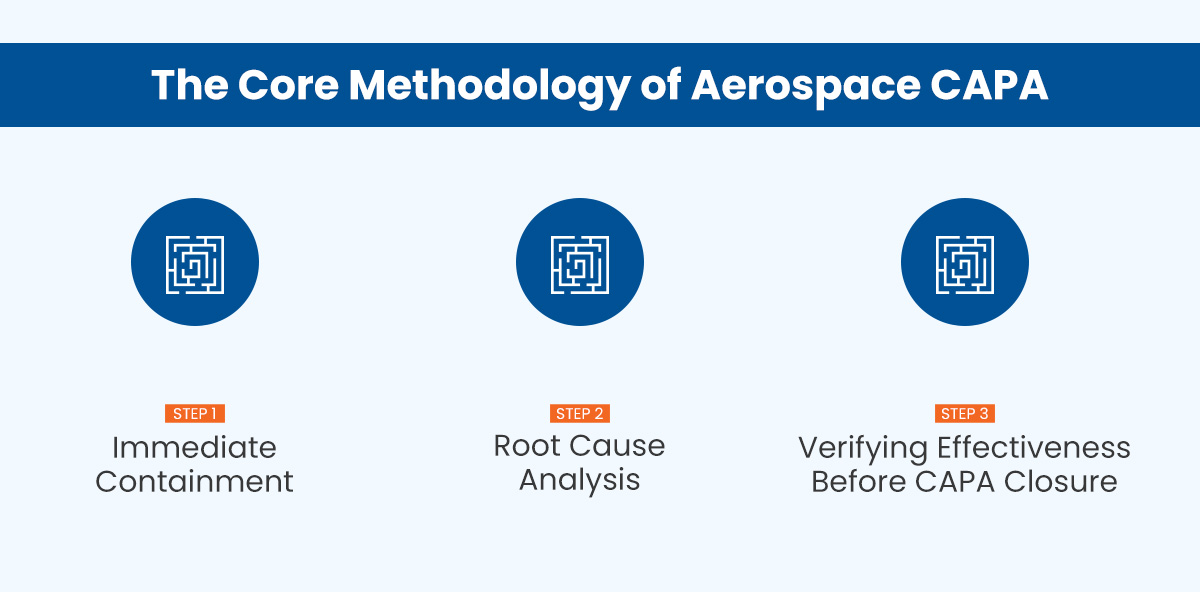
Step 1: Immediate Containment
Containment prevents nonconforming products from reaching customers or subsequent production stages. AS9100D requires organizations to control nonconforming outputs to prevent their unintended use or delivery. Teams must implement containment within hours of discovering the issue, not days or weeks.
Effective containment includes segregating suspect material, inspecting potentially affected inventory and implementing temporary process controls. Organizations should establish containment procedures that define responsibility and establish verification steps. Documentation must record what was contained, how containment was verified and when normal operations resumed.
Containment addresses immediate risk as the first step in corrective action. Many organizations close CAPA records after implementing containment, leaving root causes unaddressed and allowing recurrence. Containment is the first step in a complete corrective action process, not the final one.
Step 2: Root Cause Analysis
RCA identifies why the nonconformity occurred and why existing systems failed to prevent or detect it. Surface-level investigations produce surface-level corrections that fail to prevent recurrence. AS9100D requires organizations to determine the causes of nonconformities and implement action to eliminate those causes.
Aerospace organizations employ several structured methodologies for root cause investigation:
- 5 Whys: The 5 Whys asks “why” repeatedly until the investigation reaches systemic causes rather than symptoms. It works well when the problem involves simple cause-and-effect chains, but can miss complex interactions.
- Fishbone (Ishikawa) diagrams: With Fishbone diagrams, you have visual tools categorizing potential causes into groups. They help teams consider multiple contributing factors but require skilled facilitation to avoid superficial analysis. Also known as the Ishikawa diagram after its creator, this tool organizes contributing factors into six groups: manpower, machine, material, method, measurement, and Mother Nature (environment). The resulting diagram resembles a fish skeleton, with the problem statement at the head and cause categories forming the bones.
- Fault tree analysis (FTA): FTA maps the logical relationships between failures, systematically working backward from the observed nonconformity to identify all potential contributing causes. It’s particularly effective for complex aerospace systems where multiple factors contribute to failure.
The 8D problem-solving process represents the aerospace industry standard for major nonconformances and is explicitly required by most OEMs for Level 2 and Level 3 corrective action requests. This structured methodology ensures comprehensive investigation and verification through eight distinct disciplines:
- Establish the team (D1): Form a cross-functional group with the process knowledge and authority to solve the problem and implement corrective actions. Effective 8D teams include representation from quality, engineering, production and often supply chain or materials management.
- Describe the problem (D2): Define the problem in measurable terms, specifying what is wrong, where it has been detected, when it occurs, and the extent of the issue. Vague problem statements lead to ineffective corrective actions — specificity is essential.
- Implement interim containment (D3): Put immediate actions in place to isolate the problem from customers while the investigation continues. This step formalizes the containment actions discussed earlier and includes verification that containment is effective.
- Identify root causes (D4): Determine all potential causes, test each to verify actual root causes and confirm with data rather than assumptions. This discipline separates 8D from less rigorous methods — root causes must be proven, not theorized.
- Choose permanent corrective actions (D5): Select the corrective actions that will eliminate root causes and verify they resolve the problem without creating unintended consequences. This includes both occurrence and escape corrective actions for customer escapes.
- Implement corrective actions (D6): Put the permanent corrective actions in place, remove interim containment measures and monitor long-term effects. Implementation includes updating procedures, retraining personnel and modifying inspection plans as needed.
- Prevent recurrence (D7): Modify management systems, operating systems, practices and procedures to prevent recurrence of this and similar problems. This discipline addresses systemic changes beyond the immediate corrective actions.
- Recognize the team (D8): Acknowledge the team’s collective efforts and share lessons learned across the organization. This step ensures knowledge transfer and reinforces the value of thorough problem-solving.
Step 3: Verifying Effectiveness Before CAPA Closure
AS9100D explicitly requires proof of effectiveness, yet many quality systems treat implementation and verification as the same milestone. These are distinct milestones. Implementation means the corrective action has been put in place, while verification means the action has been confirmed to prevent recurrence.
Verification requires three elements: sufficient time to observe results, objective measurement criteria and documented evidence. Organizations should establish verification periods based on production volume and cycle time. Criteria might include defect rates, process capability indices, audit findings or customer complaints. Documentation should record what was measured, over what period and with what results.
Secure online portals like Launchpad enable real-time CAPA tracking and visibility into verification status. Inspection scheduling, verification milestones and supporting documentation are captured in these systems. They provide 24/7 access for both suppliers and OEMs to monitor progress through the verification window without relying on email exchanges or manual status reports.
Closing CAPA records without verified effectiveness creates the illusion of quality improvement while allowing root causes to persist. Effective corrective action plans include verification criteria and timelines from the outset, establishing clear expectations before implementation begins.
Occurrence vs. Escape: 2 Failures, 2 Corrective Actions
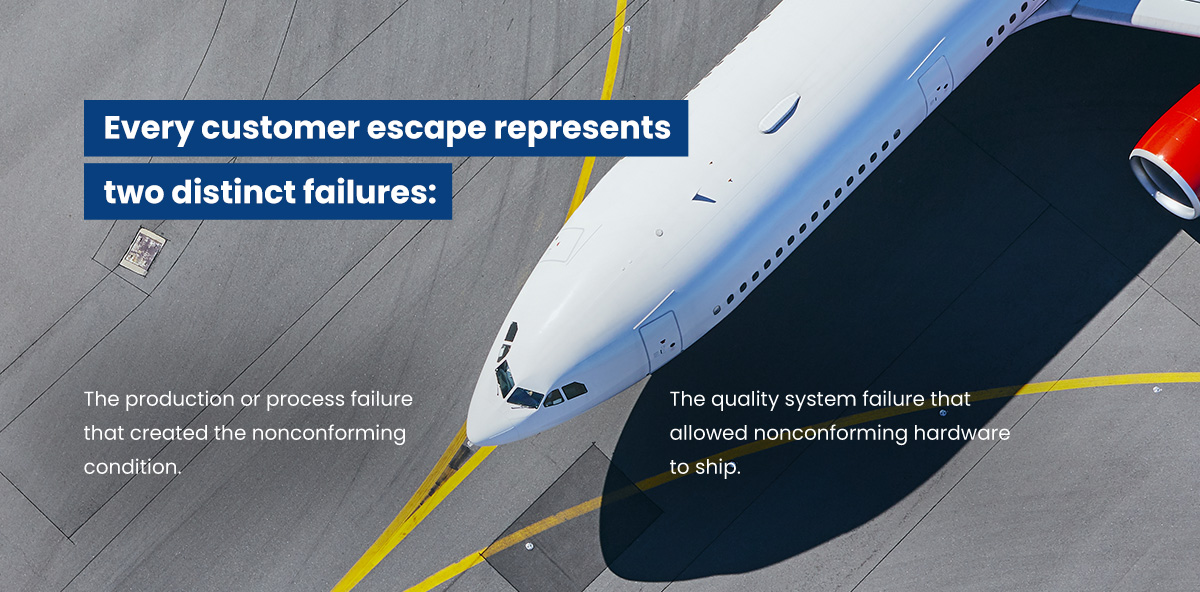
Conflating the occurrence point and the escape point is the single most common reason CAPAs fail to prevent recurrence. Every customer escape represents two distinct failures: the production or process failure that created the nonconforming condition and the quality system failure that allowed nonconforming hardware to ship. Each failure requires its own corrective action.
1. Corrective Actions for Occurrence
Corrective actions addressing the point of occurrence target the production or service process where the nonconformity first emerged. These corrections require detailed knowledge of materials, equipment, methods and environmental factors that influence output quality.
The investigation must identify which inputs varied, which controls were insufficient and which process parameters require tighter specification. Organizations then implement changes that eliminate the variation, including revised work instructions, enhanced operator training, improved tooling, upgraded equipment or modified process parameters.
Internal quality audits can uncover systemic issues, such as faulty escape points, that individual CAPA investigations miss. Common examples include:
- Revising heat treatment procedures after discovering improper hardness
- Implementing poka-yoke devices after assembly errors
- Upgrading measurement equipment after discovering inadequate process capability
2. Corrective Actions for Escape
Corrections addressing the escape point target detection capabilities within the quality system. These actions require a thorough understanding of inspection procedures, measurement systems, acceptance criteria and error-proofing mechanisms.
The investigation must identify why existing inspections, tests or checks failed to detect the nonconformity before it progressed downstream. Organizations then implement changes that close the detection gap, such as revised inspection procedures, enhanced measurement systems, additional verification points, improved acceptance criteria, or upgraded testing equipment.
First article inspection (FAI) per AS9102 standard documentation ensures new or modified parts meet all design requirements before serial production begins. When escape analysis reveals inadequate FAI protocols or verification gaps, corrective actions should address both the inspection methodology and the completeness of documentation to prevent similar escapes.
Effective escape corrections close the quality system gap, improving your organization’s ability to identify nonconforming materials before they reach customers or subsequent operations.
Common CAPA Implementation Challenges
Aerospace organizations face recurring obstacles when implementing CAPA systems. Understanding these challenges helps quality teams anticipate and proactively address them.
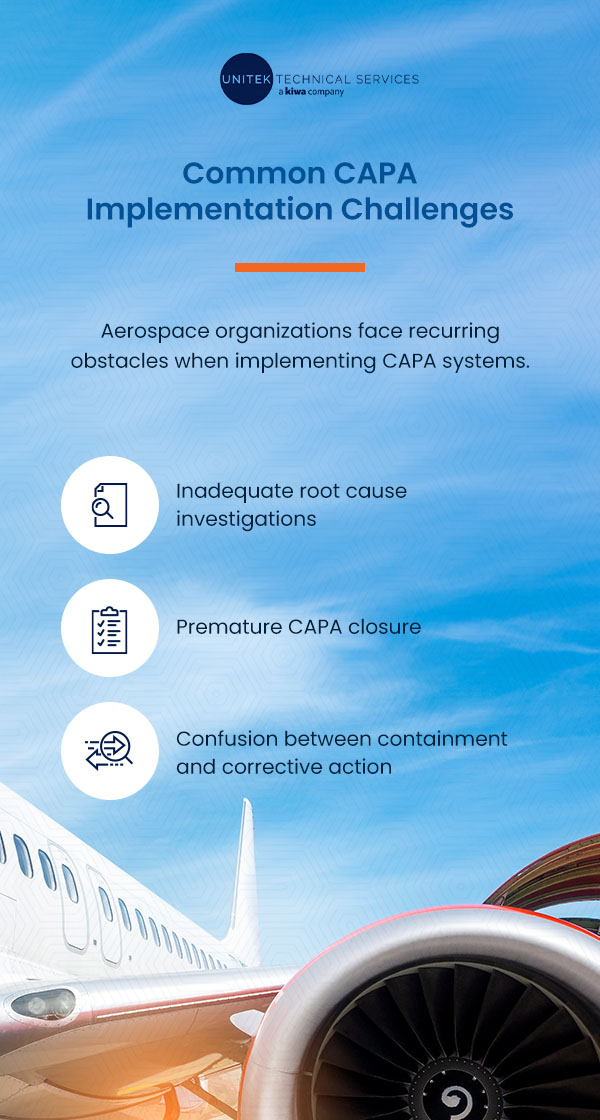
- Inadequate root cause investigations: Effective investigations follow a discipline. Identify the immediate failure, determine why existing process controls allowed it to occur and identify why quality system controls failed to detect it before progression. This three-level analysis provides the foundation for comprehensive corrective action.
- Premature CAPA closure: Organizations face pressure to close CAPA records quickly to demonstrate responsiveness to auditors and customers. This pressure often results in closure before effectiveness has been verified. Teams implement corrections, document the changes and close the record without confirming that recurrence has been prevented.
- Confusion between containment and corrective action: Implementing containment measures — segregating nonconforming material, sorting suspect inventory and adding inspection points — addresses immediate risk as a temporary control measure. Yet many organizations close CAPA records after containment, treating temporary controls as permanent solutions.
Implementing Preventive Action Programs
While corrective action responds to confirmed failures, preventive action anticipates and addresses potential nonconformities before they occur. Aerospace organizations implement preventive action through systematic risk identification and mitigation.
FMEA-Driven Prevention
FMEA identifies potential failure modes, assesses their severity and likelihood and prioritizes risk mitigation. Aerospace organizations conduct design FMEAs during product development and process FMEAs during manufacturing planning.
High-risk failure modes trigger preventive action regardless of whether failures have occurred. Organizations implement additional controls, design changes, redundant verification or alternative processes to reduce risk priority numbers below acceptable thresholds. These preventive actions address problems that FMEA predicts, but field experience has not yet confirmed.
Trend Analysis and Early Warning Systems
Systematic monitoring of quality metrics reveals deteriorating performance before nonconformities exceed specification limits. Organizations tracking first-pass yield, scrap rates, rework frequency or customer returns can identify adverse trends while processes remain within specifications.
Statistical process control charts provide early warning when processes drift toward specification limits. Organizations can initiate preventive action when control charts show patterns — seven consecutive points on one side of the centerline, increasing range or approaching control limits — even when all parts remain within specification.
This approach prevents failures rather than waiting for specifications to be exceeded. Preventive actions might include process audits, equipment maintenance, operator retraining or procedure revisions that are implemented proactively rather than reactively.
Systematic Process Capability Review
Regular process capability studies identify operations approaching inadequate Cpk before they produce nonconformities. AS9100D requires organizations to determine process capability for aerospace operations, particularly those producing critical or key characteristics.
Organizations should establish capability review cycles based on production volume and product criticality. Processes with Cpk values between 1.33 and 1.67 warrant more frequent review than those demonstrating higher capability. When capability studies reveal declining performance, teams initiate preventive action to restore process centering, reduce variation or tighten process controls.

Partner With Unitek Technical Services for Supplier Quality Excellence
A successful aerospace CAPA program requires engineering depth, process discipline and a commitment to verifying results. Organizations that maintain this level of rigor benefit from reduced supply chain risk, improved compliance performance and the operational capacity to focus on core competencies rather than constant firefighting.
Unitek Technical Services partners with aerospace organizations to strengthen their quality systems through proven supplier quality and development services. Our technical specialists bring the aerospace engineering depth required to support effective RCA, containment response and verification protocols. With over 50 years of experience in aerospace supply chain quality, we understand the resource intensity of maintaining a disciplined CAPA process.
Contact us to discuss how we can support your CAPA program.