
Aerospace quality management programs for Tier 1 suppliers include contracts, audits and flow-down obligations. The parts and materials flowing from Tier 2 and Tier 3 suppliers operate outside direct visibility, yet that’s often where the quality risk originates.
Without formal oversight, nonconformances, unauthorized material substitutions and process deviations propagate upward undetected. By the time they reach receiving or production, corrective action is more costly and disruptive. Managing quality control for sub-tier aerospace suppliers is a structural requirement for organizations looking to maintain AS9100 compliance, full traceability and cost control.
Why You Need More Than Tier 1 Oversight
Original equipment manufacturers (OEMs) and primes maintain contractual relationships and quality visibility with Tier 1 suppliers through purchase orders, supplier audits and performance scorecards. That visibility diminishes rapidly at Tier 2 and Tier 3, where raw materials, special processes and machined components originate. Contracts typically bind only the parties directly involved. Privity of contract means Tier 1 suppliers are responsible for their sub-tiers, but that responsibility is not always enforced or verifiable from the OEM level.
Sub-tier supplier invisibility creates a structural blind spot that manifests in several ways:
- Late problem detection: Problems are generally found when a nonconforming part or delivery delay reaches the Tier 1 level, often after sub-tier issues have compounded.
- Limited visibility into root causes: OEMs’ focus on Tier 1 leaves sub-tier challenges largely unaddressed, making it difficult to trace quality issues to their origin.
- Undetected process changes: Unauthorized process changes at sub-tier levels only surface when corrective action is most costly.
- Exposure to quality escapes: Without formal sub-tier oversight, nonconforming parts and traceability gaps can spread upward through the supply chain undetected.
How Quality Requirements Flow Down the Aerospace Supply Chain
Flow-down is the formal mechanism by which prime contract requirements pass through purchase orders and quality clauses into subcontracts at every level of the supply chain.
What AS9100 Clause 8.4.3 Requires of External Providers
AS9100 clause 8.4.3 governs information that organizations must communicate to external providers. Commonly flowed requirements include the right of access to suppliers, the obligation to report nonconforming products, additional customer terms and conditions, and product safety and ethical behavior per AS91XX:2016 standards. Any requirement deemed not applicable must be justified with documented information. Omission without documentation is itself a compliance risk.
For defense programs, Defense Federal Acquisition Regulation Supplement clauses and Defense Priorities Allocations System obligations create additional mandatory flow-down requirements. Clarifying the AS9100 standard for external provider requirements confirms these obligations apply to aerospace quality management programs across all supply chain tiers.
Where Flow-Down Breaks Down in Practice
Organizations rarely skip writing the requirement entirely. Instead, quality intent fails to survive translation across tiers intact. A sub-tier may technically receive the drawing but miss a customer specification, a shelf-life rule or a key inspection characteristic. In weaker programs, quality intent fragments across purchase order attachments, email and tribal knowledge, creating gaps at the sub-tier level without the prime being aware.
Privity clauses in contracts can limit direct OEM access to sub-tier supplier facilities and data. Assessment overload compounds the problem. Organizations with large sub-tier bases often cannot audit all suppliers thoroughly, leading to superficial compliance checks that do not identify real process risk.
How to Extend Quality Control into the Sub-Tier
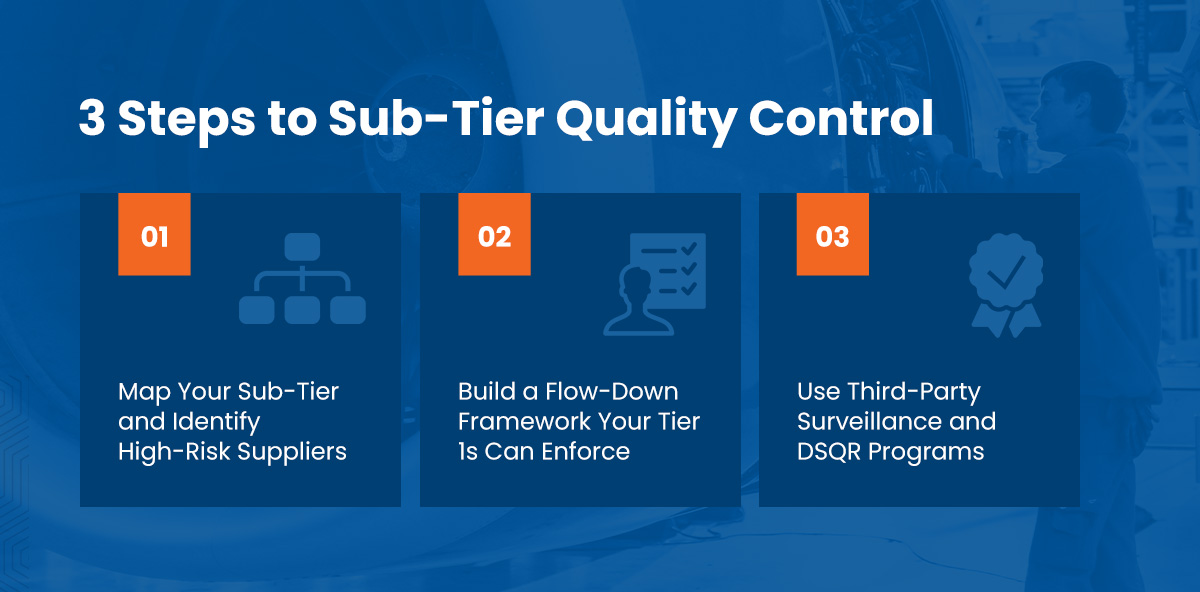
Extending quality control into the sub-tier requires an active, structured oversight model, not a one-time audit. The following three steps form a sequential framework for a quality management system for the aerospace industry at Tier 2 and Tier 3:
Map Your Sub-Tier and Identify High-Risk Suppliers
Supplier mapping approaches include supplier surveys and questionnaires, collaborative process mapping and formal quality audits. Prioritize oversight based on part criticality, such as flight-safety vs. non-critical, special process involvement, past delivery and quality performance and financial stability of the sub-tier.
Capacity assessments evaluate both capability and the ability to meet demand now and in the future. Supplier performance management programs track quality and delivery metrics to identify risk before it continues upward.
Build a Flow-Down Framework Your Tier 1s Can Enforce
A flow-down framework is only effective if it is specific enough for Tier 1 suppliers to actually pass down and enforce. Effective flow-down includes the following elements:
- Material controls: Requirements for material traceability, certification and approved sources to prevent unauthorized substitutions.
- Special process approvals: Documentation of qualified processes such as welding, heat treatment and coating that require specific certifications.
- Inspection methods and traceability expectations: Clear definition of inspection points, measurement requirements and traceability documentation at each tier.
- Record retention and reporting obligations: Specifications for how long quality records must be maintained and which events trigger notification to upper tiers.
- Mandatory change notification: Tier 1 cannot unilaterally change process, source, tooling or sub-tier supplier where approval is required without OEM awareness, as this creates uncontrolled process variation.
The IAQG Supply Chain Management Handbook provides guidance for continuously improving On Quality Delivery and On Time Delivery across the supply chain. AS9100 flow-down obligations for external providers establish the baseline, but effective programs build on it with customer-specific requirements tailored to their risk profiles.
Use Third-Party Surveillance and DSQR Programs to Fill the Gap
Even the most thorough flow-down framework requires verification. Most organizations do not have the internal bandwidth to surveil sub-tiers directly.
Third-party supplier surveillance and Designated Supplier Quality Representative (DSQR) programs extend quality reach without adding internal headcount. DSQR administration includes screening recommended candidates, training on customer-specific inspection program requirements, customer systems access and registration, stamp control and reviewing annual certification and personnel requirement compliance.
Supplier scorecard and reporting programs provide data review for quality and delivery performance at macro and micro levels. Timely feedback enables corrective or preventive action before issues propagate. DSQR administration and supplier reporting programs transition from reactive, pass/fail compliance to proactive, process-maturity oversight.
One supplier surveillance case study demonstrates how proactive oversight stabilizes manufacturing processes, minimizes the cost of poor quality and eliminates special causes of variation before parts ship.
The Real Risks When Sub-Tier Quality Goes Unmonitored
Sub-tier quality gaps create three categories of risk that compound when visibility ends at Tier 1:
- Counterfeit parts: SAE AS5553 standardizes practices to maximize authentic parts availability and control suspect or confirmed counterfeit electrical, electronic and electromechanical parts. Counterfeit risk in aerospace supply chains increases with each tier intermediary. A sub-tier sourcing from an unauthorized distributor creates exposure that the prime has no visibility into.
- Traceability gaps: In June 2023, the industry discovered a London-based parts broker had sold aircraft engine parts using falsified documentation. The Aviation Supply Chain Integrity Coalition was formed in response, recommending enhanced traceability and vendor accreditation controls across all supply chain tiers.
- Parts nonconformance escaping detection: Parts nonconformance discovered late in the production cycle results in higher cost to correct, schedule disruption and potential compliance findings. By the time it propagates to Tier 1, the issue may already be incorporated into assemblies. Earlier verification at the sub-tier level isolates the problem before it compounds, reducing scrap, rework and downstream schedule impact.
Partner With Unitek Technical Services a Kiwa Company for Sub-Tier Quality Control
Managing sub-tier quality control requires visibility into who is producing parts at Tier 2 and Tier 3, a flow-down framework specific enough for Tier 1 suppliers to enforce and third-party verification to confirm compliance.
Unitek Technical Services a Kiwa Company provides quality oversight into sub-tier supply bases without requiring additional internal resources. We specialize in partnering with aerospace organizations, serving as an extension of your quality team. With over 45 years of experience, we provide Supply Chain Management services including risk analysis, capability assessments and sub-tier control, as well as Technical Support Services including DSQR administration, supplier scorecard reporting and specification compliance.
Schedule a supply chain risk assessment or supplier surveillance engagement to identify control gaps before they result in compliance findings. Helping customers deliver products the world can trust.