
In the aerospace and defense industries, maintaining quality products is essential. Your clients will use your products in mission-critical products, and often, people’s safety, well-being and mission success will be on the line. With this in mind, you can understand the importance of ensuring you’re producing products that work as intended for each of your clients’ specified requirements.
You need to be sure your manufacturing process creates repeatable, conforming products. Your clients want the confidence that they can trust your products to fulfill their requirements and on-time goals. To achieve true product compliance, stability and accountability, you need to complete and document the first article inspection (FAI). An FAI is a baseline measurement of your processes, a crucial part of your quality control plan, so it’s vital to document it properly.
What Is AS9102 First Article Inspection?
AS9102 is the aerospace industry standard for documenting the FAI, a comprehensive verification process that ensures your production processes consistently produce parts that meet all engineering requirements. The quality management system standard provides a structured framework for creating First Article Inspection Reports (FAIRs) that document conformance to design specifications.
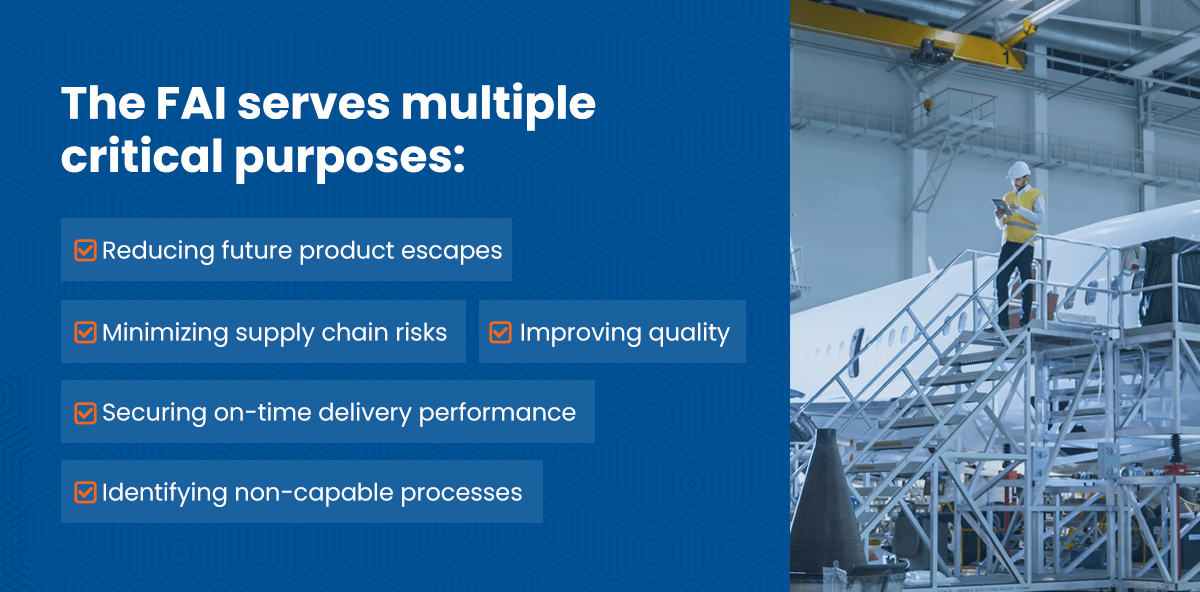
When you conduct an AS9102 FAI, you’re establishing objective evidence that your manufacturing process can deliver repeatable, conforming products. The FAI serves multiple critical purposes:
- Reducing future product escapes
- Minimizing supply chain risks
- Improving quality
- Securing on-time delivery performance
- Identifying non-capable processes
This baseline measurement becomes your reference point for serial production, giving you and your clients confidence in product compliance and process stability.
When to Conduct an FAI
There are specific instances when you must conduct an FAI to ensure characteristic accountability of your manufactured products. The most common scenario in which you’ll need to complete an FAI is after finalizing a purchase order contract between you and your client. In most cases, the buyer will require an FAI in the purchase order contract to ensure the product meets their specifications.
The Society of Automotive Engineers provides other examples of when you would need to conduct an FAI, such as after the following:
- The first production run of a new product: Before producing something for the first time, complete an FAI to ensure it meets all your criteria.
- Implementing a change in a product’s design: Design changes can be more than cosmetic. After altering an item’s design, an FAI is necessary to ensure it was created as specified.
- Changing the sources or materials: Changing the materials you use in a product or the parties from which you source them can impact functionality. Performing an FAI after making such a change will help you maintain a consistently high level of quality for your customers.
- Two years have passed since the initial product run: Staying abreast of your production performance, tooling and special processors is a crucial part of quality control and meeting your customers’ needs.
- Any change in manufacturing tools, processes or location: An FAI ensures your products meet your customers’ criteria, but it also reveals whether your manufacturing process can maintain consistent quality. If you change any part of your process, including the location or tools, you must conduct another FAI.
AS9102 Versions: Rev A, Rev B and Rev C
In June 2023, the International Aerospace Quality Group (IAQG) released AS9102 Rev C to improve clarity and align the standard with modern digital manufacturing practices. This latest revision addresses evolving industry needs while maintaining the core verification principles established in earlier versions.
Rev C updates include refined definitions for FAI types, enhanced support for Digital Product Definition (DPD) and formal recognition of electronic signatures. According to the IAQG’s official change documentation, these modifications streamline the verification process while reducing documentation ambiguity. Adopting Rev C allows organizations to expect reduced risk and fewer product escapes through improved process clarity and documentation requirements.
Key Changes From Rev B to Rev C
Transitioning from Rev B to Rev C includes several critical form and process updates:
- Form 1 Field 17: Changed from “Partial/Complete” to “Part Type” for clearer classification
- Form 1 Field 19: The “Signature” field is now Field 20, which is designated as “FAIR Reviewed By”
- Signature field removal: Forms 2 and 3 no longer include signature fields, consolidating accountability on Form 1
- Electronic signature recognition: Formally acknowledges digital signature methods for modern workflows.
- FAI type definitions: Refined terminology distinguishes between complete, partial and delta FAI requirements more precisely
- Review and approval separation: Two different individuals now perform the “FAIR Reviewed By” and “FAIR Approved” functions
Enhanced Support for Digital Product Definition (DPD)
Rev C provides formal requirements for the use of 3D models and CAD datasets by the design authority. This is a significant shift from traditional 2D drawing-based processes. The enhancement recognizes that many aerospace suppliers now rely on model-based definition practices for design and manufacturing.
The updated standard addresses how to extract and verify design characteristics directly from digital models, ensuring your verification process aligns with modern digital-first manufacturing workflows. This change reflects the industry’s ongoing transition toward integrated digital product development, where 3D models serve as the single source of truth for design specifications, dimensions and geometric tolerancing.
How Rev C Impacts Your FAI Process
Your team should update internal procedures and FAIR forms to align with Rev C requirements to ensure acceptance during customer reviews. The separation of review and approval responsibilities means you’ll need at least two qualified individuals involved in finalizing your FAIR — one to complete the “FAIR Reviewed By” step and a different person to perform the “FAIR Approved” function.
Verify that your current forms match the Rev C field structure, particularly the renumbered fields on Form 1. Additionally, if you’re working with digital product definitions, ensure your process captures and documents characteristics from 3D models in accordance with the new DPD guidelines. As AS9102 integrates with other evolving aerospace quality standards, such as AS9145 Advanced Product Quality Planning, maintaining alignment across your quality systems becomes increasingly important for compliance and efficiency.
The Importance of an FAI
Here are some reasons an FAI is essential to any successful manufacturing run:
- Product quality: An FAI represents the finished product’s quality. If the FAI reveals problems, nonconformances or shortcomings, you’ll know you need to adjust your production processes. The completed FAIR verifies you have met your clients’ requirements.
- Process quality: In addition to confirming product conformity, an FAI will validate the manufacturing process, ensuring you can reproduce the results your client is seeking. Performing an FAI will let you know if you’re ready to engage in more product runs or if you need to make any tweaks to your manufacturing process to achieve more desirable results.
- Documentation and tooling: An FAI also verifies the material and special process documentation, in addition to the tooling you use throughout your manufacturing process, thus ensuring you have objective evidence of the product conformity. Having authenticated FAI documents on hand gives you the information you need about your process when you need them — for example, in postmortem reviews and evaluations — benefiting you and your clients alike.
- Buyer and manufacturer peace of mind: You and your client want certainty throughout the transaction. Your client deserves assurance that their product will meet their specifications. You need faith that your process will yield the desired results during the current and each future manufacturing run. An FAI will give you and your client the definitive proof you need to move forward with the process.
The 3 Forms in an AS9102 FAI
According to AS9102, every complete FAI in the aerospace and defense industry must include three forms. You should familiarize yourself with these so you can better know what to expect from your FAI and what you’ll be responsible for doing and providing throughout the inspection process.
Here are the three forms in an AS9102 FAI.
- Form 1 — Part Number Accountability: Form 1 includes all the information needed to describe the assembly or part that the FAI is verifying. Included are all applicable documentation, product serialization, revision levels, part names and numbers, organizational name and an assembly parts list with traceable information. Lastly, Form 1 includes the completed FAIR or approval information.
- Form 2 — Product Accountability: Form 2 will capture materials, special processes and functional testing applicable to the first article part or assembly. List these in chronological order as they appear in the manufacturing process. At a minimum, the Material Cert packages will consist of the Material Supplier C of C and the Manufacturer’s Cert and Test Report. Form 2 addresses all materials, special processes and specifications where subsequent monitoring or measurement cannot verify the resulting output. If you use a substitution material or special process per customer substitution documentation, record that information on Form 2. Maintain and furnish evidence of traceability between the material cert and work order or traveler.
- Form 3 — Characteristic Accountability: Form 3 includes the evaluation and verification of every identifiable characteristic of the product, like performance and dimensional requirements. Form 3 will include test or inspection results for each of these characteristics. An example is gauge identification, which demonstrates that you met every product requirement in the first article sample. Form 3 also includes any instances in which either party accepts or identifies nonconformances.

FAI packages should include bubble drawings, model screenshots or sketches denoting design characteristics and a parts list showing all the unique part characteristics, including all drawings plus general and flag notes. This information must include your approval and traceability to the authority dataset. The unique characteristic accountability must correspond with a unique identifier on the bubbled drawing, sketch, screenshot or a link to a CMM report.
Other crucial components of an FAI package include:
- Material certifications
- Process certifications
- Completed FAI forms
- Nonconformance documents
- Test reports or results
- Casting or forging approvals
- Completed work order and any re-work orders representing the manufacturing process, as required
- Copy of the customer’s condition of supply, as required
- Customer approval of frozen planning outside the data sheet (outside processor) or the manufactured engineering planning instruction control number
- Supplier information requests
- Other fabrication records as indicated in CMM reports such as point maps and setup instructions, as required
- Along with the part number, log a unique identifier on the supporting documents, such as an FAI report number or manufacturing process reference number
Common Reasons for AS9102 FAIR Rejections
Form 2 presents the most common challenge. Suppliers fail to include complete material or special-process certifications. Every material used in your first article requires traceability documentation, including Material Supplier Certificates of Conformance and the Manufacturer’s Certification and Test Reports. Correcting missing or incomplete certifications is necessary before approval.
Form 3 rejections typically stem from incomplete or incorrect characteristic accountability. You’ll need corresponding inspection results for each identifiable characteristic, including the calibrated measurement tools used and their serial numbers. Ensure your bubble drawings or model screenshots clearly denote all design characteristics with unique identifiers that correspond to your Form 3 entries. Gaps in characteristic documentation or mismatches between your drawings and assessment results require correction before approval.
Other frequent issues include:
- Missing nonconformance documentation when applicable
- Incomplete traceability between work orders and material certifications
- Failure to obtain proper customer approval for substituted materials or processes
Avoiding these FAIR rejections is a key component of effective supply chain risk management, helping you maintain on-time delivery commitments and customer confidence.
How to Create a FAIR
Now that you understand more about FAIs and the forms that you need for a completed first article inspection report, it’s time to learn how to create one for yourself. Handling your FAIRs yourself could be a convenient and cost-effective option, though it will require more work on your end than having a third party handle your first article inspection needs. Here are the five steps you must take when creating a first article inspection report for your processes.
- Plan your FAI: To start, you must gather all the documents needed for a successful FAI. These include digital product information, engineering drawings, data sets, specifications, materials lists, work orders, manufacturing planning documents and sourcing information. For your FAIR, you’ll also need to prepare the three forms listed in the previous section.
- Create an inspection plan: In this step, you’ll create an itemized drawing with numbered “balloons” that point to individual dimensions and part requirements. These numbers correlate to those listed on Form 3. You’ll also prepare your AS9102 forms according to the information required for each.
- Manufacture your first article: You will then perform your initial production run to acquire your first article for inspection. Be sure to document the process and inspection results. Remember that the first article does not have to be the initial item you produce. It can be anything selected from the first production run.
- Collect data: For this step, you will use the inspection plan from step two to inspect the first article accordingly. Be sure to keep track of your certified, calibrated inspection tools. You may need to trace these tools back to the people qualified to use them to perform the inspections or manufacture the first article accurately.
- Create your report: Finally, you will create your FAIR. Enter your results into AS9102 Form 3. Include the serial numbers of used tools, a functional test report, measured results, any applicable nonconformance information and a certificate of conformance.
The FAI Process
In short, the FAI process involves the following:
- Performing a limited production run
- Selecting assemblies or a part to test, which is the first article
- Testing and inspecting each part of the first article assembly, or the individual part selected
- Documenting the results in a FAIR, including objective evidence
The inspection process helps the involved parties verify the product’s functional and physical characteristics against specifications, drawings, design documents and purchase order information. This information will go on the FAIR at the end of the process. Here is some of the information that must be on a completed FAIR:
- Revision level
- Parts numbers and descriptions
- Any applicable drawing numbers
- The customer’s purchase order number
- The name and signature of the person completing the FAI
- The date of the completed inspection
- Proof of the customer’s approval
- The review of the process(es) and materials
- Functional test methods and results
- The COC number
- The measurement of the product’s physical characteristics
Follow the five steps of creating a FAIR, and be sure to include all the information listed above to ensure valid results in your product’s first article inspection.
AS9102 FAI: Frequently Asked Questions
AS9102 becomes mandatory when your customer specifies it in the purchase order contract. While the standard itself is an industry best practice, its enforcement depends on contractual requirements between you and your customer.
Is AS9102 a Mandatory Requirement?
AS9102 becomes mandatory when your customer specifies it in the purchase order contract.
Most aerospace and defense buyers require AS9102 FAI compliance to ensure suppliers can consistently produce parts meeting their specifications. While the standard itself is an industry best practice, its enforcement depends on contractual requirements between you and your customer.
What Is the Difference Between AS9102 and AS9100?
AS9100 is the overarching quality management system standard for the aerospace industry, establishing requirements for your organization’s entire quality framework.
AS9102, by contrast, focuses specifically on the FAI process and documentation. Think of AS9100 as the foundation of your aerospace quality system, while AS9102 provides the detailed methodology for verifying initial production capability. Both standards work together as part of comprehensive supplier development programs.
When Should I Perform a Full FAI vs. a Partial FAI?
AS9102 outlines both full and partial FAIs. A full FAI re-verifies every characteristic and is required for new parts or major changes. A partial FAI, or delta FAI, re-verifies only affected characteristics following specific changes, made more explicity by Rev C. Always document why a partial FAI is chosen over a full FAI. When in doubt, perform a full FAI to avoid costly rejections.
What Is “Objective Evidence” in AS9102?
Objective evidence refers to documented, verifiable data that proves conformance to requirements. In an AS9102 context, objective evidence includes:
- Measurement results from calibrated tools
- Material certifications with traceability
- Special process documentation
- Functional test results
- Any records demonstrating that your first article meets the specified characteristics
Objective evidence ensures reproducibility and traceability. Someone reviewing your FAIR should be able to verify your conclusions based on the documented evidence you provide.
How Does AS9102 Rev C Differ From Rev B?
Rev C, released in June 2023, introduces refined form structures, enhanced support for digital product definition, and separated review-approval responsibilities.
Key differences include renumbered Form 1 fields, removal of signature fields from Forms 2 and 3, formal recognition of electronic signatures, and specific requirements for working with 3D model-based definitions. Suppliers using Rev B will need to update their procedures and forms to maintain compliance with current customer expectations.
How Unitek Technical Services Can Help
Unitek Technical Services is ready to help you with your FAI needs. Our expert services are available for any stage of your manufacturing process, including creating and implementing your FAIR. We understand the importance of product verification for your business and how proper inspections and verifications can help you improve your product quality while reducing costs. That’s why we want to share our expertise with you as you seek a successful FAI for your product.
You and your business as a whole have a lot to do as you plan your upcoming product manufacturing run. We can help enhance your back-end operations so you can stay focused on your core competencies and whatever else matters most to you in achieving your business goals. We offer rapid, scalable and efficient technical support services to help you keep up with your supply chain needs as you validate your suppliers’ quality through FAI.
Contact Us Today
Unitek has been helping businesses like yours achieve smoother back-end operations for decades. We’ve grown over the years to offer an ever-expanding range of management and technical support services across industries, with a specific focus on the aerospace and defense industries. Our experience sets us apart, and we want to share our resources and exceptional, proven approach with your business to help you achieve new heights of success.
We’re ready to help you comply with standards and consistently apply procedures and policies to add value to your offerings and maximize your return on reinvestment. Contact us today for more information.