

Onboarding new aerospace and defense suppliers in manufacturing carries consequences that extend far beyond a single purchase order. Whether the need arises from supply chain gaps, program expansion or a new component requirement, the qualification process must account for the regulatory compliance that AS9100 and customer contracts demand.
Organizations that rush supplier approval or rely on informal vetting expose their programs to challenges in the aerospace supply chain, including nonconformance risk, schedule delays and audit findings. A structured qualification process addresses these risks by verifying supplier capability before production begins.
What Aerospace and Defense Supplier Qualification Must Address
A compliant supplier qualification process in the aerospace and defense regulated environment must verify that prospective suppliers meet baseline quality management system (QMS) requirements. They should also be capable of producing parts that conform to engineering specifications. The depth of qualification scales with component criticality and the supplier’s track record. A first-time supplier producing flight-critical components requires more rigorous vetting than an established distributor supplying commodity hardware.
Key verification requirements for aerospace and defense suppliers include the following:
- Quality management system certification: AS9100 Rev D certification for manufacturers or AS9120B for distributors of aerospace commodity items. Note that AS9100 is expected to become IA9100, and AS9120B is expected to become IA9120 in late 2026. Organizations should prepare for this transition while maintaining compliance with current Rev D and Rev B standards.
- ITAR registration where applicable: Organizations handling defense articles or technical data must maintain current International Traffic in Arms Regulations (ITAR) registration.
- NADCAP accreditation for special processes: Suppliers performing heat treating, welding, nondestructive testing, or other special processes require accreditation through the National Aerospace and Defense Contractors Accreditation Program.
- Risk-based evaluation criteria: Assessment depth determined by part criticality, supplier performance history, and sub-tier supply chain complexity.
The International Aerospace Quality Group (IAQG) OASIS database serves as the authoritative source for verifying active, accredited AS9100 certification.
The Supplier Qualification Process
A defensible supplier qualification process in aerospace and defense follows a consistent sequence, from initial screening through first article sign-off.
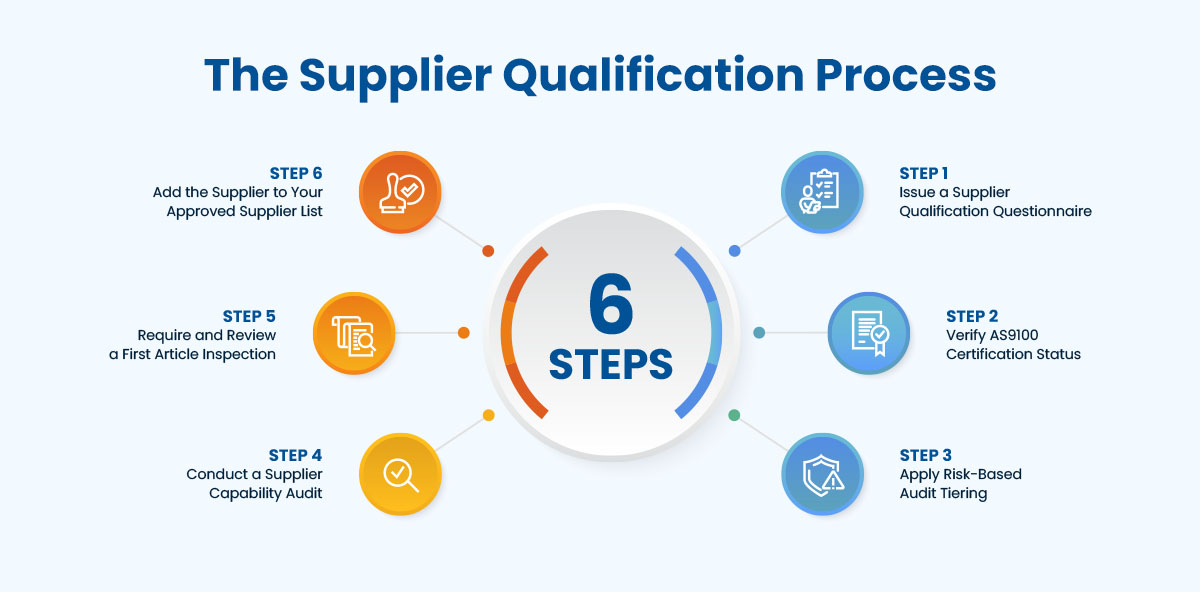
Step 1: Issue a Supplier Qualification Questionnaire
The qualification process begins before an audit or site visit occurs, with a structured questionnaire sent to the prospective supplier to gather baseline information. The questionnaire should capture quality management system certification status and ITAR registration, production capabilities and equipment, capacity and lead time commitments, key personnel qualifications, and sub-tier supplier controls.
Responses help the quality team determine whether the supplier meets minimum threshold requirements to proceed further and inform audit tiering in Step 3. The IAQG Supply Chain Management Handbook provides industry-standard frameworks for structuring supplier evaluation questionnaires across the aerospace supply base.
Step 2: Verify AS9100 Certification Status
Before any purchase order is issued, the supplier’s AS9100 certification must be independently verified, not taken at face value from a certificate the supplier provides. OASIS serves as the IAQG’s centralized database for verifying that a supplier’s certification is active, current, and issued by an accredited certification body.
Major OEMs, including Boeing, Lockheed Martin and RTX, require OASIS verification as a baseline condition for approved supplier list inclusion. It must cover the scope of work being purchased. A supplier certified for machining operations cannot be approved for chemical processing without separate accreditation.
Step 3: Apply Risk-Based Audit Tiering
AS9100 Rev D Section 8.4 explicitly calls for a risk-based approach to supplier control. Organizations must determine the type and extent of controls based on the potential impact on the ability to meet customer requirements.
Suppliers producing flight-critical components, entering a first-time relationship or demonstrating limited quality history require on-site audits. Those in the medium-risk category may be handled remotely through documentation review and virtual assessments. Lower-risk or commodity suppliers may proceed with desktop verification when the AS9100 certification scope aligns with purchased items.
Risk factors include part criticality, supplier’s AS9100 certification scope, prior performance history, sub-tier complexity and whether special processes are involved. This tiering determines the audit approach in Step 4.
Step 4: Conduct a Supplier Capability Audit
The audit evaluates the supplier’s QMS implementation, shop floor controls, document management, nonconformance processes, calibration systems and corrective action effectiveness. This is a structured assessment of the supplier’s ability to consistently produce a conforming product. The audit format — on-site or remote — follows the risk tiering determined in Step 3.
Findings are documented, and corrective actions must be closed before the supplier can advance to the approved supplier list. Organizations managing multiple simultaneous qualifications or working across geographies often supplement internal teams with third-party audit programs and Supplier Development services to maintain consistent qualification standards.
Step 5: Require and Review a First Article Inspection
Before a new supplier moves into serial production, a First Article Inspection (FAI) must be completed and documented in accordance with AS9102 Rev C, the current aerospace standard effective June 2023. At first mention, the full name applies. Subsequent references use “the FAI.” The FAI validates that the supplier’s production processes can produce parts that meet all engineering and design requirements and that those processes are stable and repeatable.
It produces objective evidence — documented on AS9102 Forms 1, 2 and 3 — that design characteristics, materials, special processes, and functional testing requirements have been accounted for and verified. Sub-component FAIRs, process records and material reports must be organized in advance to support the inspection. Organizations still using AS9102 Rev B forms should transition to Rev C, as major primes increasingly reject older revision submissions.
Leading aerospace manufacturers reference First Article Inspection requirements as a mandatory documentation milestone before serial production approval. Organizations may conduct source inspection during the FAI to verify process controls at the supplier’s facility.
Step 6: Add the Supplier to Your Approved Supplier List
Once the questionnaire, certification verification, audit, and FAI are complete and all findings are closed, the supplier can be formally added to the organization’s Approved Supplier List.
ASL entry should be documented with the evidence collected across each step, including a completed qualification questionnaire, OASIS certification verification record, audit report with closed findings and completed AS9102 Rev C FAI package. It creates a traceable qualification trail for each approved supplier. ASL status is not permanent and must be maintained through ongoing performance monitoring addressed in the next section.
Maintaining Supplier Status After Qualification
Supplier qualification is not a one-time event. AS9100 Rev D requires organizations to monitor and review the performance of external providers, including re-evaluation based on performance data, as part of ongoing supplier control under Section 8.4. Maintaining ASL status requires continuous oversight to ensure continued compliance and identify risks earlier in the production cycle.
Ongoing supplier management should include:
- Performance scorecards: Track quality, delivery, responsiveness and compliance metrics through an aerospace supplier scorecard framework that quantifies performance across multiple dimensions.
- Supplier Corrective Action Requests: Issue SCARs when nonconformances occur, requiring a documented root cause analysis and closure of corrective actions before resuming deliveries.
- Requalification triggers: Production gaps exceeding 12 months, facility moves, process changes, ownership transfers or declining performance metrics may require partial or full requalification.
A structured scorecard approach allows organizations to track supplier production in real time and make proactive decisions about risk mitigation. The IAQG Supply Chain Management Handbook provides frameworks for ongoing supplier performance management across the supply base.