
In aerospace, defense, energy and similar quality critical industries, the two inspection gate approaches work best together as a layered strategy based on evaluate supplier performance.
The decision is not about choosing one over the other. It is about deploying each method where it delivers the greatest value. The goal is to match the level of verification to the actual risk involved from both a product criticality and supplier performance standpoint.
The Cost of Late Detection
The 1-10-100 Rule holds that the cost of resolving a nonconformance multiplies by 10 at each stage it goes undetected. A nonconformance corrected at the supplier’s facility costs a fraction of what it costs to resolve at the receiving dock. By the time nonconforming material reaches the production line, those costs can compound significantly.
The American Society for Quality (ASQ) Cost of Quality framework treats prevention costs as investments that reduce the far higher costs of failure. When organizations forego source inspection to reduce costs, they often absorb far greater expenses when nonconforming material reaches production.
How Source Inspection Works
Source inspection verifies part conformance at the supplier’s facility before the lot is released. A qualified inspector reviews purchase order requirements, material certifications, witnesses functional or nondestructive tests, verifies dimensions against drawings, and confirms process parameters. Findings are documented in real time while the production setup is still active.
The Inspection and Test Plan (ITP) defines what is verified, at which stage of production and to which acceptance criteria. Traceability in regulated industries requires that materials meet specifications before entering the supply chain. Catching nonconformances at the source allows the supplier’s quality team to act on findings while the production setup is still active.
How Receiving Inspection Works
Receiving inspection is the last verification checkpoint before incoming material enters your production floor. Receiving inspection typically begins with a visual check for shipping damage and quantity verification against the packing slip. Inspectors then review supplier certifications and conduct dimensional sampling of incoming lots.
Acceptance Quality Limit (AQL) sampling determines how many units to inspect from a given lot. Sample size and acceptance criteria are determined by lot size and the nonconformance rate for the part classification. The ANSI/ASQ Z1.4 and Z1.9 standards define the switching rules for normal, tightened and reduced inspection levels based on supplier performance history.
Receiving inspection is a baseline compliance requirement under numerous quality management systems, including ISO 9001 and IATF 16949.
The Differences Between Source Inspection and Receiving Inspection
Understanding how these two approaches differ helps quality managers apply each one where it has the most impact.
- Primary goal: Source inspection validates part conformity during production and at final. Receiving inspection verifies that the delivered material matches the purchase order requirements.
- Location: Source inspection occurs at the supplier’s facility before shipment. Receiving inspection is conducted at your facility after delivery.
- Timing: Source inspection takes place during or immediately after production. Receiving inspection happens after the supplier has produced the article, performed final inspection and shipped the lot.
- Personnel: Source inspection is conducted by a customer quality engineer, third-party inspector, or approved designated representative. Receiving inspection is performed by your internal quality team.
- Resolution: Source inspection allows nonconforming parts or materials to be corrected before shipment. Depending on customer quality program requirements, quality nonconformances detected can be “handed back” to the supplier for rework. Some quality program plans require rejecting the lot, documenting the nonconformance, supplier rework, then rescheduled reinspection. Both source inspection approaches work but documenting the nonconformance and reason for the rework is important to understand recurring areas of supplier quality control weakness. Receiving inspection typically requires quarantining the lot pending disposition, which can compound schedule and cost impacts.
- Cost: Source inspection requires travel and third-party service fees. Receiving inspection uses internal labor with no travel requirement.
Selecting the Right Inspection Approach for Your Quality Management System
Choosing the proper combination of both source inspection and receiving inspection starts with understanding the specific risk factors in your quality program.
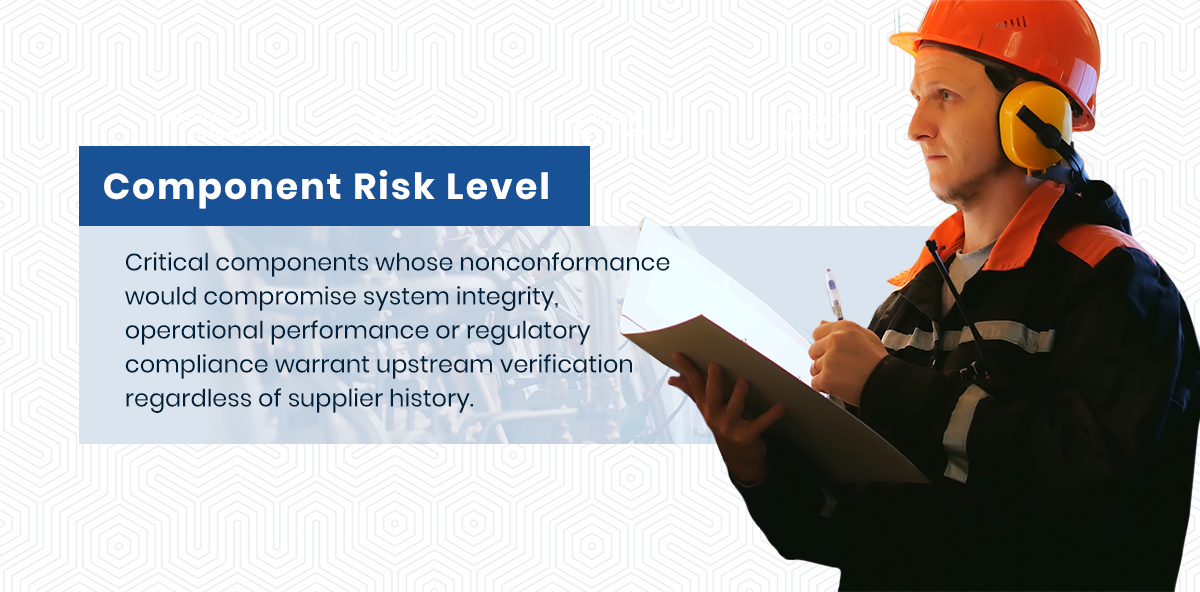
Component Risk Level
Critical components whose nonconformance would compromise system integrity, operational performance or regulatory compliance warrant upstream verification regardless of supplier history. Flight-critical aerospace assemblies, implantable medical devices, pressure boundary components and similar parts typically require source inspection before leaving the supplier’s facility.
Supplier Maturity
Suppliers with documented conformance histories and mature quality management systems may qualify for receiving inspections or reduced inspection frequency. New suppliers or those with recent nonconformance history require closer oversight.
Geographic Distance
When suppliers are located internationally or across multiple time zones, resolving nonconformances that were discovered during receiving inspection can be expensive and time-consuming. Source inspection reduces the risk of international return shipments and extended lead times.
Regulatory or Contractual Requirements
Certain industries mandate specific verification activities. AS9100-certified aerospace programs often require First Article Inspection (FAI) and ongoing source inspection for critical characteristics.
Medical device manufacturers operating under FDA 21 CFR Part 820 must validate supplier processes and verify conformance to design specifications. Defense contracts frequently include flow-down requirements specifying source inspection for government source-inspected items.
Production Risk Tolerance
Organizations operating with lean inventory, just-in-time delivery schedules or high-volume production runs have a lower tolerance for receiving nonconforming material. A rejected lot at the receiving dock can halt production and delay delivery schedules.
Using Source and Receiving Inspection Together
Most quality programs do not choose between source and receiving inspection. They use both, calibrated to supplier risk and part classification. Source inspection covers the highest-risk suppliers and most critical components. Receiving inspection serves as the baseline for all incoming material, regardless of supplier tier.
As suppliers build a track record of consistent conformance, inspection frequency can be reduced in accordance with defined switching rules. Skip-lot and reduced inspection give quality teams a data-driven way to lower inspection overhead while maintaining program visibility. The ANSI/ASQ Z1.4 switching rules define the framework for moving between normal, tightened and reduced inspection levels based on supplier performance history.
Tracking supplier scorecards and tying inspection-level changes to defined performance thresholds keep the combined model effective.
Gaps That Can Weaken Quality Inspections
Even well-established inspection programs can develop gaps that reduce their effectiveness. Recognizing these gaps is the first step toward improvement.
- Over-relying on supplier certifications: Certificates of conformance document what the supplier produced, not what was verified. Effective programs periodically validate certifications through physical inspection.
- Treating receiving inspection as a formality: When receiving inspection is treated as a documentation review rather than a physical verification, nonconforming material can enter production undetected.
- Foregoing source inspection to reduce costs: The savings of foregoing the required inspection procedures rarely offset the cost of a nonconforming batch reaching production, as the 1-10-100 Rule demonstrates.
- Not acting on inspection findings: Inspection data has limited value if it does not feed back into supplier scorecards, corrective action requests and qualification decisions. Quality metrics should help drive improvement, not just document outcomes.
Building a Smarter Inspection Program With Unitek Technical Services
The right inspection strategy aligns with your program’s specific risk profile. Source inspection and receiving inspection are complementary tools that work best when deployed together, calibrated to supplier performance data and part classification. Unitek Technical Services partners with organizations across regulated industries to build and refine inspection programs that reduce supply chain risk.
Our technical specialists bring industry-specific expertise across the full range of inspection and quality management services, from source inspection at the supplier’s facility to program-level support. Contact us today to learn more about our inspection services and how we can support your quality program.