
Many organizations choose their audit format based on budget or routine practice. Some schedule remote audits because they’re cheaper. Others use on-site audits because that’s what they’ve always done. Most choose a format for the wrong reasons.
For manufacturers in the aerospace, defense, automotive and medical industries, choosing the appropriate format is essential to maintaining full supplier visibility. Remote audits work for management system reviews and documentation checks at established suppliers. On-site audits are necessary when you need to observe active processes, assess physical controls or evaluate new suppliers.
Understanding the differences is critical for approving suppliers and maintaining healthy partnerships.
What Is a Remote Quality Audit?
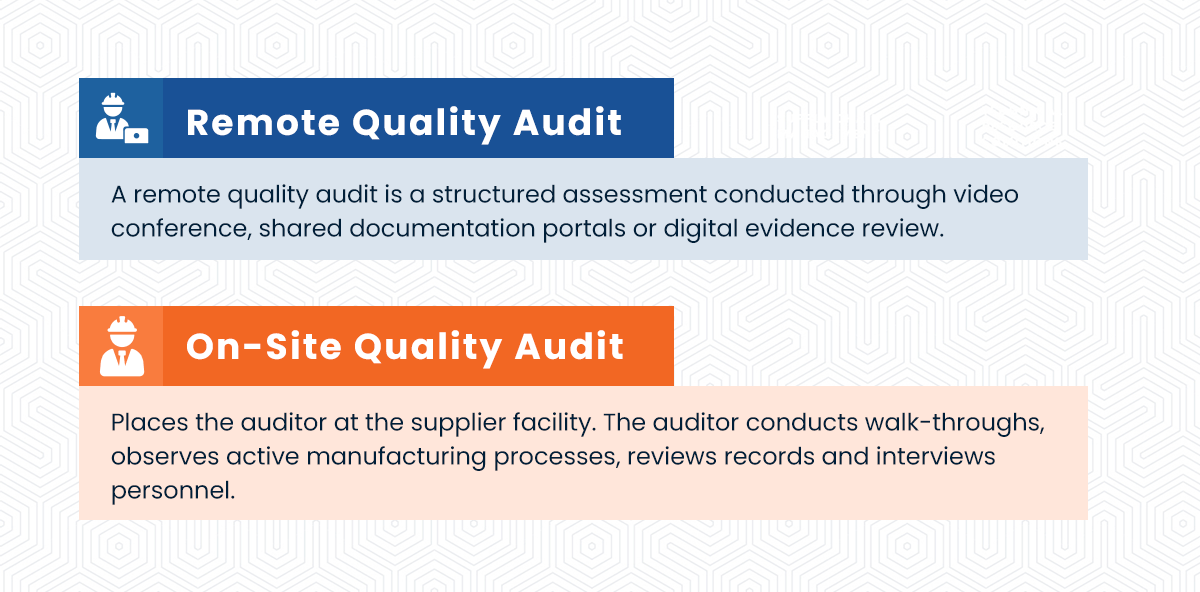
A remote quality audit is a structured assessment conducted through video conference, shared documentation portals or digital evidence review. The auditor never enters the supplier facility. These audits are well-suited for document-based verification, including procedure reviews, quality records, corrective action histories and management system compliance.
Remote audits cannot fully evaluate physical process controls, facility conditions, equipment calibration setups or personnel behaviors on the production floor. Documentation shows what should happen. Observation shows what actually happens.
Major regulatory bodies permit remote audits under specific conditions. The Food and Drug Administration (FDA) has a framework for remote regulatory assessments (RRA) for medical device suppliers. The International Aerospace Quality Group (IAQG) governs the use of remote audits for AS9100-registered organizations.
Both frameworks require risk assessment and scope limitations.
What Is an On-Site Quality Audit?
An on-site quality audit places the auditor at the supplier facility. The auditor conducts walk-throughs, observes active manufacturing processes, reviews records and interviews personnel. On-site audits surface what documentation misses, including supplier quality culture, physical process control implementation, calibration practices and nonconformances that never make it into corrective action logs.
Executing an on-site audit requires the supplier’s direct cooperation. The supplier must provide facility access, make relevant personnel available and have documentation ready for contextual review. That level of engagement also makes on-site audits more resource-intensive than remote assessments.
Pros and Cons of Remote and On-Site Audit Formats
Neither format is universally better. The differences lie in what each one can verify, what it costs and how well it satisfies your audit objectives.
- Cost: Remote audits typically eliminate travel and per diem costs. On-site audits usually entail higher total costs due to travel, logistics and auditor time.
- Scheduling: Remote audits generally require less coordination. On-site audits require facility access planning, travel logistics and auditor scheduling that can extend lead times.
- Observation: Remote audits are limited to documentation and digital evidence. On-site audits involve direct observation of facility conditions, active processes, personnel and physical controls.
- Regulations: Remote audits are accepted under the FDA and IAQG frameworks with specific conditions. On-site audits satisfy all major regulatory requirements.
- Supplier engagement: Remote audits limit interaction to screen-based communication. On-site audits enable on-the-floor presence and in-person supplier engagement.
- Verification: Remote audits may not satisfy verification requirements where physical observation is necessary. On-site audits are the standard for new, critical or underperforming suppliers.
When to Use Remote Audits
The decision to audit remotely should be driven by supplier performance data and audit scope, not convenience or cost. Remote audits are often the right choice in situations like:
- Established suppliers: Suppliers with consistent performance records and a history of low nonconformance rates are strong candidates for remote surveillance.
- Annual audits: Routine compliance reviews do not typically require on-site presence when a supplier’s performance record supports it.
- Documentation reviews: Procedure reviews, record audits, and Corrective and Preventive Action (CAPA) status checks are well-suited for remote review when records are accessible and current.
- Global suppliers: When audit objectives can be met through digital evidence, remote audits reduce travel costs without sacrificing verification quality.
- Digital infrastructure: Suppliers with real-time record sharing and video access to relevant areas can support effective remote assessments.
When On-Site Audits Are Warranted
Some audit objectives cannot be satisfied remotely. When verification depends on direct observation of processes, physical controls or supplier readiness, on-site audits are often warranted in situations like:
- New suppliers: Most suppliers entering the supply base for the first time warrant on-site verification before approval.
- High-risk parts: Parts with critical or high-risk classifications often require process observation to satisfy compliance requirements.
- Process audits: Nondestructive evaluation (NDE), special processes, calibration verification and manufacturing floor controls typically require physical verification.
- Underperforming suppliers: Late deliveries, elevated nonconformance rates or unresolved corrective actions typically warrant on-site investigation.
- Regulatory requirements: Some compliance frameworks mandate direct observation and cannot be met solely through documentation.
- Performance gaps: When performance data suggests issues that records cannot explain, direct observation is often the most effective next step.
The Hybrid Approach
Mature supplier quality programs do not typically choose one format. They build a tiered model that matches the supplier risk tier and the audit objective. Remote handles document and management system reviews. On-site handles process-dependent verification and suppliers that warrant closer oversight.
New suppliers usually start on-site. As a performance track record develops, remote surveillance becomes appropriate for lower-risk checkpoints. With the accumulation of supplier performance data, audit frequency and format can be calibrated accordingly.
Unitek Technical Services provides organizations across global supply chains with tailored hybrid models that meet their specific requirements. Remote audits cover established suppliers with clean records. On-site audits verify process controls at critical suppliers and new entrants.
Customers should base every audit format decision on supplier risk and audit objectives.
Common Mistakes to Avoid
The most common program-level mistakes occur when audit teams create gaps in supplier risk visibility.
- Defaulting to remote audits for cost reasons: Cost savings are measurable, but they do not offset the risk of missing nonconforming processes and resultant material. Remote audits are appropriate when they fit the supplier and the audit objective, not just when they fit the budget.
- Treating on-site audits as routine visits: Conducting annual visits that follow the same scope every time, without adjusting to supplier risk signals or recent performance data, wastes audit budget. Emerging issues go undetected.
- Inconsistent audit criteria: Remote and on-site findings must be comparable to support meaningful program data. Different formats require different verification methods, but the evaluation criteria should remain consistent.
Unitek Technical Services a Kiwa Company helps organizations build audit programs that align with supplier risk and deliver consistent, comparable findings across their entire supplier base.
Selecting the Right Audit Format for Your Program
Choosing between remote and on-site audits is a risk-based decision that depends on supplier performance history, part classification and regulatory context. Unitek Technical Services executes audit programs to help organizations across a range of industries maintain supply chain compliance and supplier performance. Contact our team today to learn more about our supplier audit services.