

When a nonconformance or incident report lands on your desk, selecting the correct root cause analysis (RCA) tool is a critical first step. This guide compares the 5 Whys, Fishbone, fault tree analysis (FTA) and Eight Disciplines (8D) methodologies, guiding practitioners to choose the most effective tool for their specific situation.
Recurring quality failures, particularly in complex industries like aerospace, incur substantial costs — from production delays and supplier nonconformances to potential compliance violations. Effective RCA is essential for preventing repeat issues, making the right tool selection paramount.
Why Choosing the Right RCA Tool Is Critical
A well-suited root cause analysis tool directly impacts system uptime, maintenance costs and operational safety. The right methodology enables earlier identification of causal factors and helps prevent costly nonconformances.
The three core methodologies — 5 Whys, Fishbone and FTA — employ fundamentally different reasoning structures: linear, categorical and deductive Boolean, respectively. The 8D method provides a structured, team-oriented framework that often uses these tools within its problem-solving process. Using a tool misaligned with the problem’s complexity, such as applying a linear approach to a multi-causal system failure, inevitably leads to an incomplete corrective action/preventive action (CAPA). The result is a superficial fix that fails to prevent recurrence, wasting resources and perpetuating compliance risks.
The stakes are substantial. AS9100 certification reduces nonconformances in aerospace suppliers, demonstrating the value of systematic quality approaches. This standard requires organizations to apply RCA to nonconformances and document the results in a manner suitable for third-party audit review.
For high-risk systems where compliance audits and regulatory scrutiny are standard, a quantifiable, defensible analysis is mandatory to demonstrate due diligence.
The 4 Core Methodologies
RCA tools differ significantly in their approach, resource requirements and ideal applications. Understanding each methodology’s strengths and limitations allows you to match the tool to your specific investigation needs and organizational capabilities.
5 Whys
The 5 Whys method uses iterative questioning to trace a problem back to its underlying cause. By asking “why,” you work backward through a chain of causation until you reach the root issue. This approach works best for straightforward problems with a clear, linear cause-and-effect path.
The key advantage lies in simplicity and speed. You can conduct a 5 Whys analysis with minimal documentation and no specialized tools, making it accessible for rapid investigations. However, this simplicity becomes a limitation when dealing with complex interactions. The method can miss contributing factors that operate in parallel or overlook systemic issues that don’t fit a linear narrative.
Consider a scenario where a critical subassembly from a supplier fails due to a combination of factors: the raw material had a subtle defect (bad material), the supplier’s incoming inspection process missed it (missed inspection), and the customer’s engineering specification was ambiguously written (incorrect spec). A 5 Whys analysis, following one thread, might stop at ‘supplier failed to inspect material,’ leading to a corrective action focused solely on supplier inspection. It overlooks the concurrent causes — the material defect and the ambiguous spec — resulting in an incomplete CAPA that fails to prevent future, potentially different, failures originating from the same systemic vulnerabilities.
The Fishbone (Ishikawa) Diagram
The Fishbone diagram provides a visual framework for mapping multiple potential causes across standardized categories. Also known as the Ishikawa diagram after its creator, this tool organizes contributing factors into six groups: manpower, machine, material, method, measurement, and Mother Nature (environment). The resulting diagram resembles a fish skeleton, with the problem statement at the head and cause categories forming the bones.
This methodology excels in collaborative brainstorming sessions where teams need to explore issues with multiple contributing factors. By organizing causes visually, teams can systematically examine each category and identify interactions between causes. The Fishbone diagram can capture diverse perspectives during team investigations. The main constraint is its qualitative nature — it collects potential causes but doesn’t measure their impact or separate root causes from symptoms.
In the context of supplier audit corrective actions, the Fishbone diagram becomes an indispensable collaborative tool. When an audit finding triggers a CAPA, suppliers often require a structured approach to brainstorm potential causes without fixating on immediate symptoms. A facilitated Fishbone exercise allows a supplier’s team to systematically explore all six “M’s”, ensuring a comprehensive view of potential contributors.
For example, if an audit identifies consistent dimensional nonconformities, the Fishbone can help the supplier’s team consider factors from tooling wear (machine) to operator training gaps (man) or inconsistencies in measurement techniques (measurement). This collaborative approach, especially when facilitated by external supplier quality expertise, transforms the brainstorming from a mere listing of ideas into a structured inquiry.
Fault Tree Analysis
FTA takes a top-down, deductive approach to modeling how component failures combine to produce system-level events. Using Boolean logic gates, FTA maps the pathways through which individual failures can propagate through a system, allowing you to calculate failure probabilities and identify critical control points. This methodology is governed by IEC 61025, which defines formal procedures for constructing and analyzing fault trees.
FTA’s quantitative rigor makes it the standard for safety-critical systems in aerospace and defense, where you must demonstrate compliance with regulatory requirements and justify resource allocation for risk mitigation. The method requires substantial up-front investment in data collection, specialized expertise and analysis tools. When the cost of failure is catastrophic or regulatory scrutiny demands defensible evidence, FTA’s ability to quantify risk and trace failure modes makes this investment worthwhile.
For highly regulated industries such as aerospace (governed by AS9100), medical devices and defense, FTA is often a regulatory expectation. For high-criticality failures, a detailed, quantifiable analysis of causal paths is mandatory to demonstrate due diligence and justify risk mitigation strategies.
In these environments, attempting to address a systemic, multi-path failure with a simpler tool like 5 Whys presents a significant compliance risk. Regulators and auditors expect the rigor and traceability offered by FTA, alongside other critical analysis tools like design failure mode and effects analysis, to validate that all potential failure modes have been thoroughly considered and addressed. Ultimately, an inadequate RCA methodology can lead to continued product nonconformances, product recalls and severe financial and reputational damage.
8D Method
The 8D method is a structured, team-oriented problem-solving approach widely used to identify, correct, and prevent the recurrence of quality issues. This methodology is a standard in industries like manufacturing, automotive, aerospace, and quality management, where comprehensive and documented corrective actions are crucial.
The 8D method is a holistic process that runs through eight specific disciplines:
- (D1) Establish the team: Assemble a cross-functional team with the necessary product/process knowledge.
- (D2) Describe the problem: Clearly define the problem using data, often employing the 5W1H (Who, What, When, Where, Why, How) method.
- (D3) Implement interim containment action: Protect the customer from the problem until a permanent solution is found.
- (D4) Identify root causes: Determine all potential causes and verify the root cause(s). This is where specific RCA tools, such as 5 Whys, Fishbone diagrams or FTA, are often employed.
- (D5) Develop permanent corrective actions: Choose the most effective corrective actions to eliminate the root cause and verify that they will resolve the problem without causing undesirable effects.
- (D6) Implement permanent corrective actions: Apply the chosen solutions to the process or product.
- (D7) Prevent recurrence: Modify systems, practices, and procedures to prevent similar problems from recurring, often through standardization and sharing lessons learned.
- (D8) Congratulate the team: Recognize the team’s collective efforts and celebrate the successful resolution of the problem.
The key strength of the 8D method lies in its systematic approach. The root cause is identified, and effective containment, corrective and preventive actions are implemented and validated. This method fosters long-term solutions, continuous improvement and regulatory compliance, making it invaluable for addressing significant, recurring or customer-impacting nonconformances.
How to Select the Right Tool for Your Challenge
Quality engineers need a clear framework to match the RCA tool to the failure. Begin by assessing:
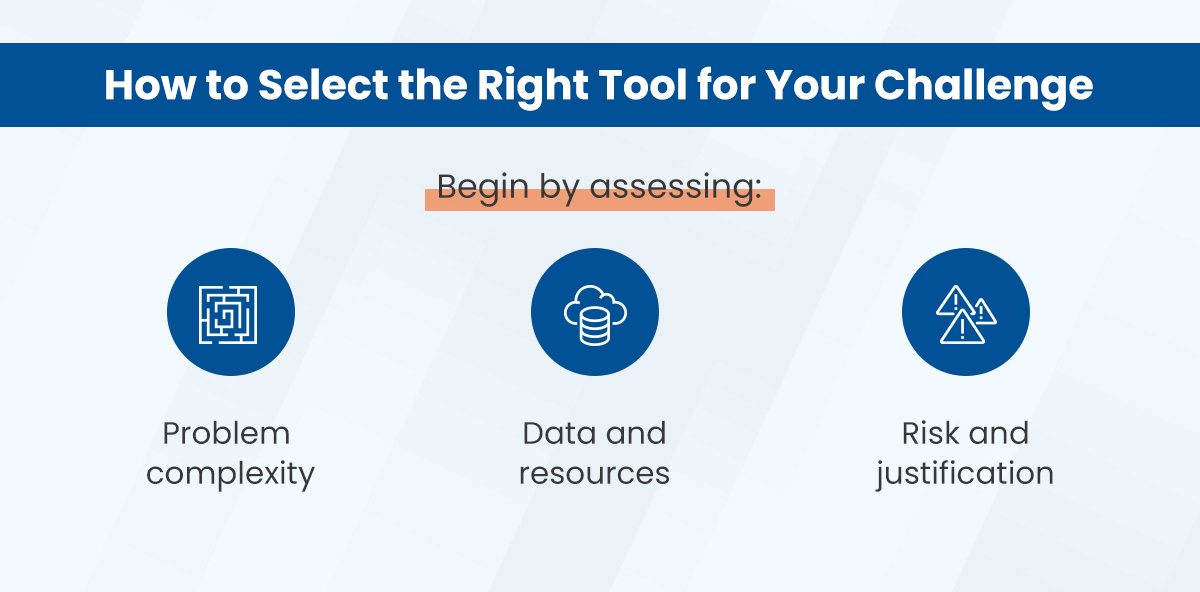
- Problem complexity: Is the failure a straightforward process deviation with an obvious linear cause? Use the 5 Whys for rapid resolution. If the problem involves multiple interacting variables where the cause is initially unknown, use the Fishbone diagram for comprehensive brainstorming. For systemic, high-risk scenarios with potentially catastrophic outcomes, FTA is required. For complex, recurring problems that demand a structured, team-based approach, the 8D method is highly effective.
- Data and resources: Consider your investigation timeline and available expertise. The 5 Whys method requires minimal resources and delivers rapid results. Fishbone diagrams demand collaborative team effort and facilitation skills, and FTA is data-intensive, typically requiring specialists trained in reliability engineering or formal risk analysis methods. The 8D method requires a dedicated cross-functional team, significant time investment and a skilled facilitator.
- Risk and justification: Evaluate the consequences of inadequate analysis and stakeholder expectations. When investigating high-risk systems where failure could result in safety incidents or regulatory violations, FTA provides the quantifiable, defensible evidence that compliance audits and executive reviews require. For significant, recurring or high-impact problems where preventing recurrence is paramount, and a thorough, documented resolution is expected, the 8D method provides a structured framework for CAPA. Comparative studies of RCA methods confirm that tool selection significantly impacts result quality, particularly in complex scenarios where inappropriate methodology can miss critical causal factors up front.
A Comparative Summary of RCA Tools
Expert-led RCA delivers substantial business impact when properly implemented. Use this table to quickly reference the differences between RCA tools:
| RCA Tool | Best Use Case | Complexity Level | Resources Needed | Main Limitation |
| 5 Whys | Simple, linear problems | Low | Minimal; quick turnaround | Can miss parallel causes and complex interactions |
| Fishbone Diagram | Complex problems require team brainstorming | Medium | Collaborative team effort, facilitation skills | Organizes ideas without quantifying impact |
| Fault Tree Analysis | High-risk, safety-critical systems | High | Data-intensive, requires specialized expertise | Significant up-front investment in time and resources |
| 8D Method | Recurring, systemic problems requiring comprehensive, documented team-based solutions and long-term prevention | High | Cross-functional team, significant time and documentation | Requires substantial organizational commitment and buy-in; not ideal for simple, quick fixes |

Partner With Unitek Technical Services a Kiwa Company
Selecting the right root cause analysis tool is the first step, but expert implementation drives measurable outcomes.
Unitek Technical Services a Kiwa Company brings over 45 years of experience applying these methodologies in demanding aerospace, defense and automotive environments. Our Technical Specialists work closely with your team to identify causal factors, implement corrective measures and validate results — allowing you to focus on your operational goals and core competencies.
Discover how our root cause analysis services reduce costs, minimize risk and enhance quality across your supply chain. Contact us today to request information and learn more from our team.