
A new NADCAP requirement from an original equipment manufacturer (OEM), a contract clause or an approved vendor list condition means one thing: you must understand the accreditation process fast.
NADCAP, managed by the Performance Review Institute (PRI), governs the critical and special processes that keep organizations compliant across the aviation, space and defense (ASD) supply chain. While AS9100 certifies a company’s overall quality management system, NADCAP accredits specific processes, such as nondestructive testing (NDT), heat treating or welding, performed within that system.
Knowing the difference and what the path to accreditation involves shapes how you prepare for broader supplier qualification standards.
What Is NADCAP Accreditation?
NADCAP accreditation is an industry-managed program administered by the PRI. It verifies that specific critical and special processes within the ASD supply chain meet standardized quality requirements. The program works differently from most certifications because the industry itself sets and enforces the standards.
- Industry-led governance: OEM subscribers define the audit criteria for each process, PRI manages scheduling and task groups made up of industry peers make the final accreditation decisions.
- A streamlined alternative to duplicate audits: Before NADCAP launched, OEMs each ran separate audits for the same processes. NADCAP consolidated the process into one standardized audit accepted industry-wide.
- Built on an existing foundation: Suppliers typically hold AS9100 or an equivalent quality management system (QMS) certification, or they complete a NADCAP AC7004 quality system audit alongside their first process audit.
Which Processes Require NADCAP Accreditation?
NADCAP accredits critical processes, also called special processes, in which conformance depends on in-process verification rather than on after-the-fact inspection alone.
Core categories include:
- Heat treating
- Welding
- Chemical processing
- Coatings
- Non-conventional machining
- Composites
- Additive manufacturing
- Materials testing laboratories
Each process requires its own accreditation, with welding, NDT and other categories following distinct audit paths. NDT services are among the most common NADCAP-accredited categories, and several methods fall within their scope, including:
- Liquid penetrant
- Magnetic particle
- Ultrasonic
- Radiographic
- Eddy current testing
If your organization performs any of these methods on ASD hardware, NADCAP accreditation likely applies to your operations.
Special Processes vs. Standard Quality Certifications
AS9100 and NADCAP work together as two layers of a complete compliance picture. AS9100 sets the foundation for a company’s QMS, while NADCAP confirms that individual processes, such as NDT, heat treating or welding, meet their own accreditation requirements. A supplier that performs all three processes typically pursues three separate NADCAP accreditations, each building on the aerospace quality standards already established by AS9100.
How the NADCAP Audit Process Works
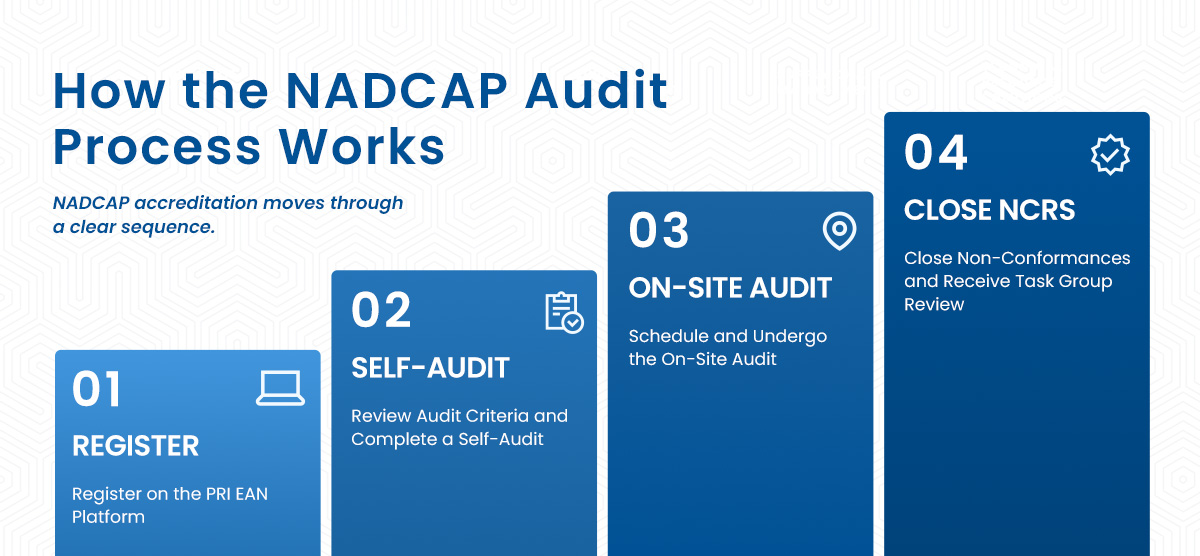
The NADCAP audit path moves through defined stages, from registration to accreditation, in a consistent sequence. What auditors examine depends entirely on the special process being audited, since audit criteria checklists and the auditors assigned to apply them are tailored to that exact scope.
Step 1: Register on the PRI EAN Platform
The first step is registering on the PRI EAN platform, formerly known as eAuditNet. EAN manages every phase of accreditation, including company registration, audit scheduling, document submission, non-conformance report (NCR) tracking and access to audit criteria and the qualified manufacturers list (QML).
Step 2: Review Audit Criteria and Complete a Self-Audit
After registration, suppliers access the Audit Criteria specific to their process, such as AC7114 for NDT or AC7102 for Heat Treating. A required self-audit against that checklist comes next, and it’s where readiness gaps are identified and closed. At this stage, teams typically review procedures, technician qualifications, equipment calibration records, process controls, job travelers, and objective evidence against the applicable checklist.
Resolving any non-conformances found during this review before the formal visit helps the full evaluation go more smoothly. Many suppliers partner with experienced audit teams at this stage to help confirm their special process operations are ready.
Step 3: Schedule and Undergo the On-Site Audit
With the self-audit complete, suppliers request a formal visit through PRI EAN, with lead time varying based on auditor availability and process demand. The on-site visit itself follows these steps:
- Opening meeting: The visit begins with a review of the scope and schedule between the auditors and the supplier’s team.
- Process review: Documentation and procedures get assessed against the applicable audit criteria checklist.
- Job audit: The special process itself is observed in action on real hardware, alongside the records that document it.
- Daily finding summaries: Observations are shared at the end of each day, keeping the supplier informed in real time.
- Closing briefing: A final summary covers all findings, including any NCRs issued.
Step 4: Close Non-Conformances and Receive Task Group Review
Suppliers respond to every NCR with documented root cause analysis and corrective action, and a PRI staff engineer reviews those responses to guide the supplier through closure. Once all NCRs are resolved to the staff engineer’s satisfaction, the audit package moves to a task group composed of OEM Subscriber experts in that specific process for review and a vote. A task group vote in favor earns the supplier a place on the QML.
Effective NCR responses usually need to show root cause, containment when applicable, corrective action, objective evidence, and steps taken to prevent recurrence.
How Long Does NADCAP Accreditation Take?
First-time accreditation typically takes 6 to 12 months, from initial registration to the final accreditation decision. Preparation and self-audit are usually the longest phase, followed by scheduling lead time, the on-site visit and NCR closure.
Actual timelines vary based on process scope, audit readiness and how quickly NCRs are resolved. Organizing procedures, calibration records and self-audit findings ahead of the formal visit, with support from experienced audit partners, helps organizations reduce NCR rework and keep each phase on schedule.
NADCAP accreditation costs vary by process, audit scope, auditor time, preparation needs, and NCR closure requirements. Suppliers should also account for internal preparation time, documentation updates, equipment or calibration corrections, and any outside audit-readiness support needed before the formal PRI audit.
How to Maintain Your NADCAP Accreditation
NADCAP accreditation operates on a periodic reaccreditation cycle, with the interval tied to performance. Strong performers can earn extended time between audits, while frequent corrective actions may mean shorter intervals. Audit criteria also evolve as task groups update requirements, so staying current and maintaining clean corrective action records supports a smooth cycle, particularly for suppliers managing supplier flow-down requirements across multiple tiers.
Partner With Unitek Technical Services for Audit and NDT Support
NADCAP accreditation moves through a clear sequence — registration, self-audit, on-site review and NCR closure — culminating in task group approval and a place on the QML. Each process category earns its own accreditation along the way.
Unitek Technical Services partners with organizations preparing for NADCAP accreditation by helping them identify documentation gaps, verify special-process readiness, and address supplier quality concerns before the formal audit. With audit, supplier quality, and technical support services, our team helps organizations manage special-process risks earlier in the production cycle while supporting supplier conformance to customer requirements.
Our certified NDT inspectors perform ultrasonic, radiographic, liquid penetrant, magnetic particle, eddy current, and weld inspection methods that fall within common NADCAP special-process categories. Contact us today to discuss your project’s needs.