

When busy program cycles consistently push an automotive test lab to its maximum capacity, it often signals a critical issue: understaffing. This problem is exacerbated by the growing demand for validation driven by Advanced Driver-Assistance Systems, electric vehicles, and software-defined vehicle testing, which severely strains existing resources.
Five key patterns tend to reveal an understaffed automotive test lab: chronic overtime, schedule disruptions due to absences, slipping design verification and product validation milestones, difficulty sustaining safety protocol compliance, and development engineers being pulled into test execution. Recognizing these signs early is crucial to preventing a staffing gap from becoming a major program risk.
Sign 1: Your Lab Is Running on Chronic Overtime
Overtime becomes a concern when it stops being the exception and starts shaping the baseline schedule. Technicians may run back-to-back test cells while extended environmental chamber cycles stretch into evenings. Overnight data pulls may start to feel routine.
A reliance on constant overtime to maintain throughput reveals a misalignment between available technician capacity and recurring test-cycle demand, often leading to deferred routine maintenance and increased human error, which results in higher repair rates.
If overtime is regularly built into the weekly schedule instead of being reserved for occasional surges, it serves as an early, measurable indicator of a structural staffing gap. This trend is exacerbated by broader industry automotive talent shortages, which stretch engineering teams and tighten timelines across the sector.
Sign 2: One Absence Disrupts Your Test Schedule
Absenteeism may look like a routine scheduling issue from the outside, but in a test lab, coverage depends on specific technical qualifications and familiarity with equipment. A test cell may depend on a technician with the right certification or knowledge of the program. If that person is out, the test may be delayed or reassigned to someone who is already at capacity.
With sufficient coverage, a single absence may require only a schedule adjustment. Without that slack, the same absence can create a test block that ripples into design verification or product validation milestone dates. Rising absenteeism in a thin lab tends to reinforce itself — remaining technicians absorb the extra load, which adds fatigue and raises the likelihood of additional absences down the line.
The result is a scheduling and throughput risk born from having too few qualified people to cover for one another.
Sign 3: DVP/PV Milestones Are Slipping Without a Clear Technical Cause
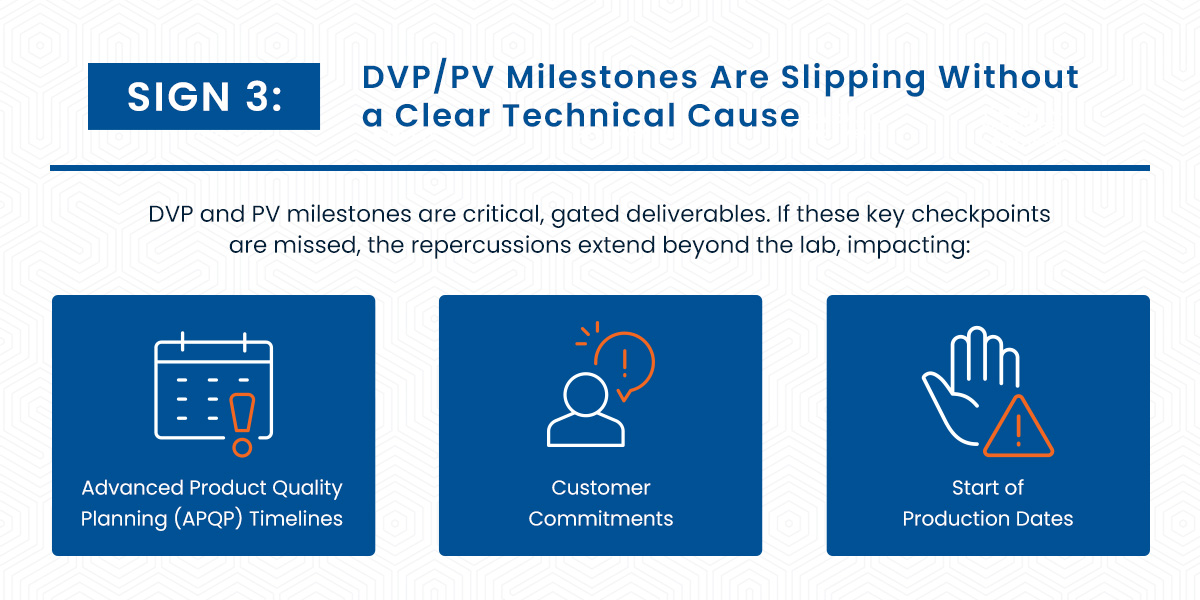
DVP and PV milestones are critical, gated deliverables. If these key checkpoints are missed, the repercussions extend beyond the lab, impacting advanced product quality planning (APQP) timelines, customer commitments and, ultimately, start of production dates.
When these milestones slip without a clear technical explanation, inadequate staff capacity is often the underlying cause. This typically results in a validation backlog, where the demand for test evidence overwhelms the lab’s ability to produce it.
Compliance with standards like ISO/IEC 17025 mandates technical competence and reliable operations. Under APQP, delays in validation directly threaten tooling release, production readiness and customer delivery. This challenge of validation resource constraints is widespread, with testing demand frequently exceeding physical capacity across the industry.
Sign 4: Safety Protocol Compliance Is Harder to Sustain
When a lab is stretched thin, test documentation, calibration check intervals and adherence to safety protocols can become harder to maintain consistently. Those operating under IATF 16949 and ISO/IEC 17025 must demonstrate they have the personnel and resource capacity to meet their technical and contractual obligations. Operating beyond that sustainable capacity creates conditions in which procedural compliance becomes difficult to maintain consistently, which elevates audit exposure and quality risk.
Addressing the capacity gap helps restore the documentation consistency and procedural discipline the lab needs to maintain normal controls.
Sign 5: Development Engineers Are Covering Test Execution Gaps
When qualified test technicians are unavailable, development or design engineers may need to step away from their primary work to run environmental chambers, collect data, manage test cell setups or cover other execution tasks.
This situation indicates a clear shift toward “firefighting” instead of proactive testing. Ultimately, time spent covering test execution is time that is no longer available for design validation, root cause analysis or system integration work. This work is instead deferred or compressed, pushing risk downstream into later program phases, where it becomes more expensive and disruptive to resolve.
While engineers filling in on the test floor are doing exactly what the situation calls for, their doing so is also the clearest indicator that a staffing gap has crossed from a lab-level inconvenience into program risk territory. These employees can cover a gap when needed, but qualified lab test technicians bring continuity that is difficult to replicate on short notice, including operation of calibrated equipment, test documentation discipline and day-to-day familiarity with specific test cells.
What to Do When You Recognize These Signs
The gap between current headcount and program demand may be more addressable than it seems, especially if organizations act before the issue becomes a missed milestone, a growing backlog of untested components or a longer-term capacity constraint.
Fortunately, organizations facing capacity constraints do not always need permanent headcount to close the gap. Flexible staffing models can help labs scale technician capacity to program demand without the timeline or payroll commitment of a permanent hire. For automotive test labs, technical resource providers who understand test execution, documentation continuity, calibrated equipment operation and the schedule pressure tied to validation milestones can give you the support you need.
The goal is to restore execution capacity, protect the consistency of documentation and provide internal engineering teams with the coverage they need to stay focused on design validation, root cause analysis and system-level work.
Scale Your Test Lab Capacity
These signs rarely appear in isolation, and each one points to the same underlying issue: the lab’s execution capacity has not kept pace, missing deadlines. Recognizing the pattern is the first step. Addressing it starts with technical support that scales with your validation workload, protects milestone progress and helps your team manage risk earlier in the production cycle.
Unitek Technical Services a Kiwa Company partners with organizations to place qualified lab test technicians, technical specialists, quality engineers, and lab managers in short- and long-term roles. Unitek helps match technical resources to your lab’s specific requirements, from test execution and calibrated equipment operation to documentation support and program continuity. Before placement, every candidate completes technical assessments, knowledge verification and a comprehensive background check.
Scale test lab capacity to match program demand without adding permanent payroll. Explore Unitek’s Laboratory Staffing Services to find the right resource for your lab’s specific technical requirements. Learn more about how our staffing solutions can benefit your organization today.