

A supplier corrective action request is issued to a supplier when a nonconformance requires investigation into the root cause, not just correction of the immediate defect. It initiates a structured process: the supplier identifies why the problem occurred, implements corrective action and shows that the action was effective.
For quality and operations teams, a well-managed SCAR helps reduce repeat issues, limit supplier back-and-forth and protect production timelines when supplier nonconformances affect delivery schedules, compliance requirements and production capacity.
What Is a SCAR?
A SCAR gives an organization a formal way to document a supplier nonconformance and require the supplier to investigate why it happened. In quality management, a SCAR serves two functions at once: it records nonconformance as objective evidence, and it opens a structured investigation for the supplier to complete for the issue to be considered resolved.
A SCAR and a standard corrective action request (CAR) differ in scope. While a CAR addresses nonconformances that originate inside the organization’s own operations, a SCAR is issued to a supplier, holding that supplier accountable for identifying and correcting the cause on their end.
These standards define the requirements that guide both the organization and the supplier:
- AS9100D Section 8.4, Control of Externally Provided Processes, Products and Services, requires organizations to monitor, control and act when externally provided products or processes do not meet requirements.
- ISO 9001:2015 Clause 10.2, Nonconformity and Corrective Action, requires organizations to react to nonconformities, investigate their main causes and confirm that corrective actions are effective, with top management ultimately accountable for how well the quality system performs.
The IAQG Supply Chain Management Handbook builds on these standards to guide supplier management practices across the aerospace industry.
When Should an Organization Issue a SCAR?
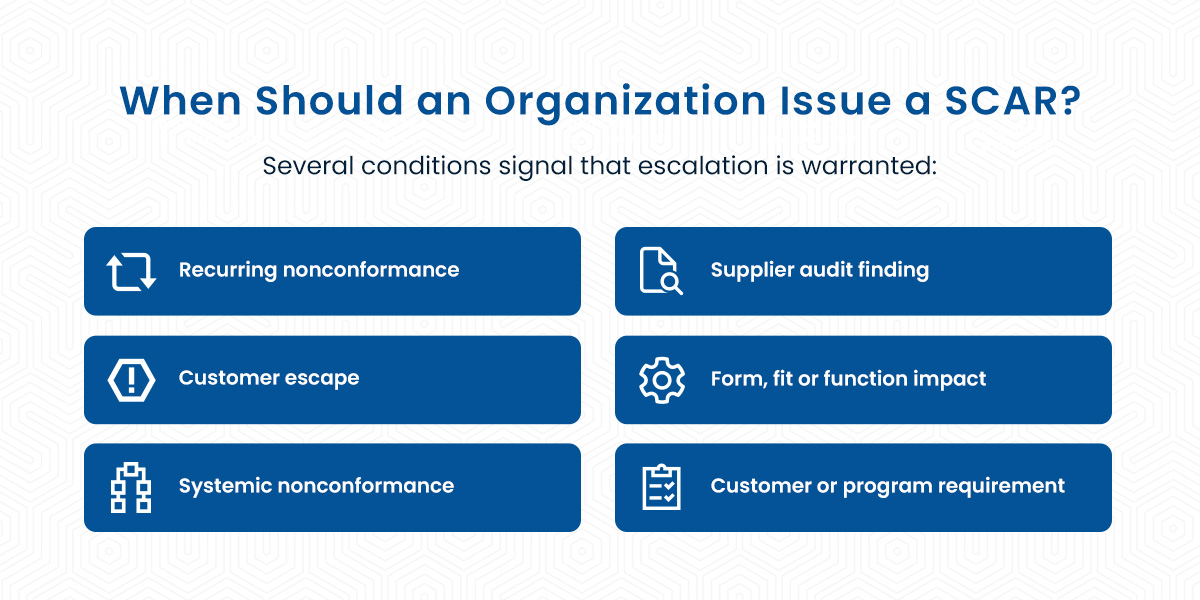
Organizations typically reserve this formal process for cases where a standard nonconformance notification isn’t enough to address the underlying risk. Several conditions signal that escalation is warranted:
- Recurring nonconformance: The same issue appears more than once within a defined window, such as 90 days, indicating the first correction didn’t hold.
- Customer escape: Nonconforming product reached a downstream customer before it was caught, which creates more risk than an issue identified before shipment or delivery.
- Systemic nonconformance: Evidence points to a process-level cause rather than an isolated event, meaning the same conditions could produce the same result again.
- Supplier audit finding: A quality audit identifies a gap in the supplier’s process controls that needs to be addressed at the source.
- Form, fit or function impact: The nonconformance affects how the part performs, assembles or operates as intended.
- Customer or program requirement: A prime contractor or program specification dictates that a SCAR be issued under certain conditions.
Deciding where a given issue falls on this scale is a routine judgment call for your quality team, drawing on established supplier qualification criteria, not a sign that something has gone unusually wrong.
SCAR Triggers vs. Standard Nonconformance Notifications
A nonconformance report (NCR) and a SCAR serve different purposes. An NCR documents what happened and what was done with the nonconforming product — scrap, rework or return — without necessarily requiring the supplier to investigate why it occurred. A SCAR goes further and requires the supplier to identify and eliminate the principal cause instead of just disposing of the affected parts.
Minor, one-off issues are often resolved through direct communication with the supplier’s quality department before a formal SCAR is ever issued. The distinction comes down to whether the organization needs disposition or needs a documented investigation.
Key Components of a SCAR
A SCAR is only as useful as the information it contains. A vague problem statement produces a like-kind response, so the request itself needs to include specific, field-level detail the supplier’s quality department can act on immediately.
A complete SCAR typically includes:
- Supplier identification: List the supplier name, part number, lot or serial number and the quantity of affected product.
- Nonconformance description: Describe the nonconformance clearly and cite the specific requirement or specification it violated.
- Objective evidence: Attach photos, measurement data, inspection records or receiving paperwork that substantiates the finding.
- Response format: Specify the required format for the supplier’s reply, such as an Eight Disciplines report, a standard SCAR form or an equivalent structured response.
- Root cause tools: Name the acceptable methods for the investigation, usually the 5 Whys, 8D or a fishbone (Ishikawa) diagram.
- Due dates: Set deadlines for each stage of the response: containment, a leading cause and corrective action plan, and effectiveness verification, based on production cadence.
Your SCAR should also list the issuing quality engineer’s contact information. The supplier will need a clear point of contact for questions, extension requests and submission confirmation.
The SCAR Process
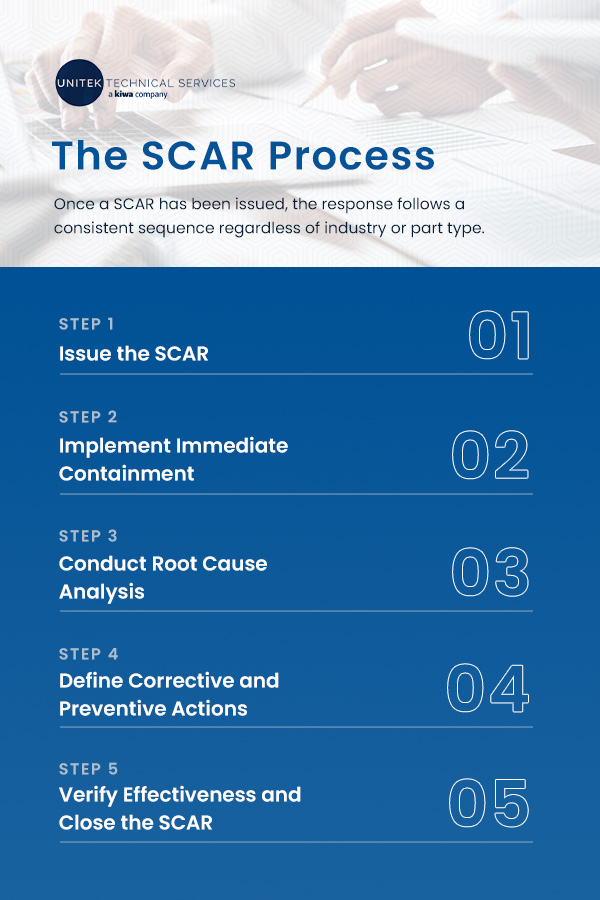
Once a SCAR has been issued, the response follows a consistent sequence regardless of industry or part type. For operations leaders, that sequence also creates a clearer way to track supplier performance, confirm deadlines and reduce the risk of unresolved quality issues disrupting production.
Step 1: Issue the SCAR
Before a SCAR goes out, the organization confirms the nonconformance is the supplier’s responsibility rather than a transit or internal handling issue. For minor or ambiguous cases, a conversation with the supplier typically happens first. Once issuance is warranted, the SCAR notification package goes out with the nonconformance narrative, a response form with required fields, due dates for each stage and the quality engineer’s contact information. Objective evidence travels with the request.
Step 2: Implement Immediate Containment
Containment is the supplier’s first response. A complete containment action accounts for every location where suspect inventory could exist, including the supplier’s facility, in transit, sitting at the receiving dock, moving through work in process and already delivered to downstream customers. Without a defined quantity and scope, it leaves gaps a partial fix can’t close.
The containment window is typically short and should be defined in the SCAR requirements. It must include segregation of suspect material, confirmation of the affected quantity and evidence that the action was actually implemented. Containment only addresses the symptom, stopping nonconforming product from advancing without eliminating why it occurred. As a result, closing a SCAR at this stage ranks among the most common and costly mistakes in the process, as the same nonconformance can resurface the moment conditions repeat.
Suppliers without in-house resources for this stage sometimes rely on third-party specialists for containment support to manage segregation, quantity verification and evidence collection.
Step 3: Conduct Root Cause Analysis
Root cause analysis in a SCAR response typically relies on two tools. The 5 Whys uses iterative questioning to trace a problem back through its contributing causes to the actual process cause. The Ishikawa, or fishbone, diagram follows possible causes across categories like man, machine, method, material, measurement and environment.
A thorough investigation addresses separate questions: why the nonconformance occurred, known as the occurrence root cause, and why existing controls did not catch it before it reached the next stage, known as the escape point. Supporting data from the investigation should substantiate each issue finding rather than rely on assumptions.
For major nonconformances, many prime contractors may require the 8D methodology, which structures the investigation, containment and corrective action into a single documented report involving a cross-functional team from the supplier’s engineering department.
The corrective action and preventive action (CAPA) framework used in aerospace covers how 8D fits into this broader process.
Step 4: Define Corrective and Preventive Actions
Corrective action targets the root cause behind the nonconformance, eliminating the specific condition that allowed the problem to occur. Preventive action targets systemic risk by applying that same fix to other products, processes or suppliers where a similar condition could exist. This step is often called read-across. Each action item in a SCAR response should include a clear description, a responsible process owner, a target completion date and a current status.
Some responses won’t meet this bar. “Employee was warned” or “employee was terminated” are not acceptable corrective actions because neither addresses the process condition that allowed the nonconformance to happen in the first place — the same gap remains open for the next person in that role. Preventive action read-across is a standard requirement for most major aerospace primes, not an optional step.
Step 5: Verify Effectiveness and Close the SCAR
Effectiveness verification determines whether the SCAR can be closed, but this step is often treated as a formality. Verification shows the corrective action was implemented as planned, while validation shows it actually eliminated the nonconformance and keeps it from recurring. Both require objective evidence, not a status update.
The effectiveness window depends on production cadence, and the criteria and timeline should be agreed upon before implementation begins, not after the fact. A corrective action generally stays open on the supplier’s record for that full window, since closure can’t happen until the evidence confirms the fix held. If the evidence falls short, the SCAR may need to be reopened and the root cause investigation revisited.
Containment, Corrective Action and Preventive Action
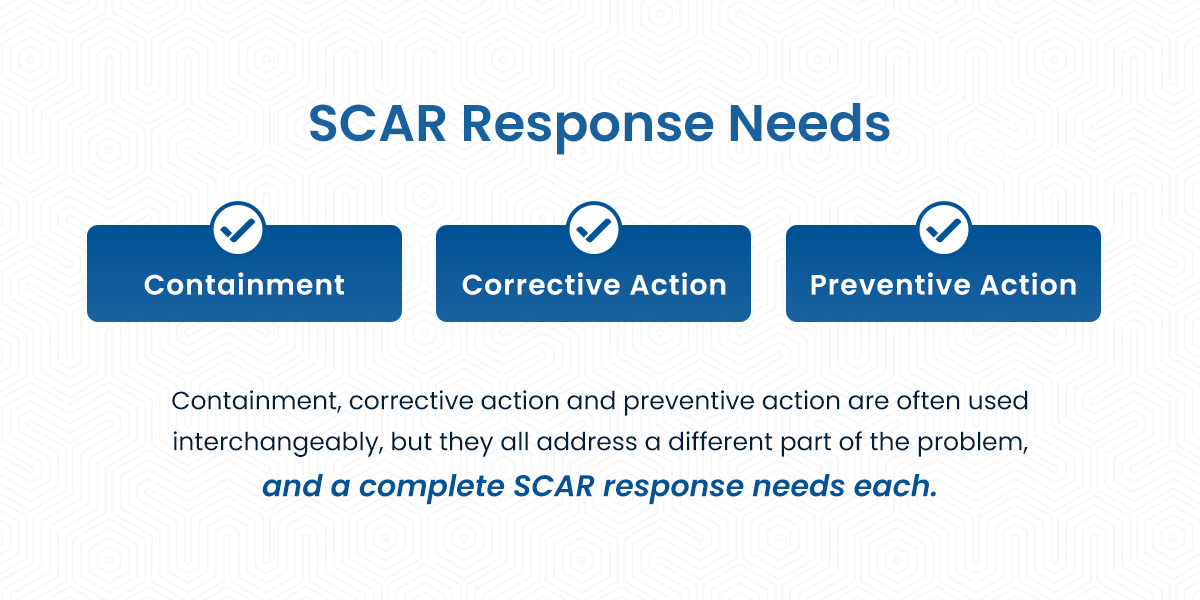
Containment, corrective action and preventive action are often used interchangeably, but they all address a different part of the problem, and a complete SCAR response needs each.
If a machining defect is discovered in a shipped lot, a supplier might implement 100% outgoing inspection on all suspect lots as containment while the investigation is underway. This step is immediate and temporary, stopping nonconforming product from advancing without touching the reason it occurred.
Suppose that same investigation finds the machining parameter fell out of tolerance because the setup procedure lacked a mandatory verification step. The permanent fix, or corrective action, would be a revised setup procedure requiring a documented sign-off before production resumes, addressing the root cause directly.
Proactively, preventive action extends that fix through read-across, applying the revised sign-off requirement to every similar machining operation at the supplier, not just the part number where the defect was found. Embedding these distinctions into a quality control plan from the outset gives both organizations and suppliers a shared reference for what each stage requires. As the earlier containment discussion noted, treating containment alone as the finish line is the leading reason corrective actions don’t hold.
A complete response ties all three together with objective evidence:
- Containment confirmed with documentation
- A root cause investigation using a recognized tool
- A corrective action plan with named owners and due dates
- Documented preventive action or read-across and an effectiveness verification plan with criteria and a timeline set in advance
Responses that fall short tend to share the same gaps — for example, a root cause of “operator error” with no deeper investigation behind it, a corrective action that only addresses the symptom, no preventive action or read-across documented, or no effectiveness verification plan at all. None of these close the loop, and accepting them sets up the same nonconformance to resurface. Tracking response quality over time, the way an aerospace supplier scorecard does for SCAR response time, helps organizations catch this pattern before it repeats.
How a SCAR Connects to CAPA
A SCAR and CAPA work at different levels of one system. SCAR is the formal request mechanism directed at a specific supplier for a specific nonconformance, while CAPA is the broader tracking and closure framework within the organization’s own quality management system that every SCAR ultimately becomes part of.
Both require the same foundation to close out, but they differ in scope. A SCAR closes out an external supplier’s response. CAPA tracks that resolution alongside every other nonconformance the organization manages internally.
AS9100D Section 10.2 and Section 8.4 work together to make this connection formal. Organizations must monitor externally provided processes and take corrective action when nonconformities occur, which means a SCAR addressed to suppliers functions as corrective action under both sections. A quality lead or management representative typically tracks SCAR and CAPA status together.
For example, when a supplier’s revised setup procedure becomes a documented, verified fix, that record becomes part of the organization’s CAPA file. The preventive action read-across applied to similar operations then helps connect supplier-level correction to organization-wide risk reduction. Decisions from the Material Review Board on nonconforming product often precede or run alongside SCAR issuance, as well.
Partner With Unitek Technical Services a Kiwa Company for Supplier Development Support
A complete SCAR response identifies the root cause of a nonconformance, corrects it permanently, applies that correction wherever else the same risk exists, and verifies the fix actually holds. Skipping any one of these steps, especially effectiveness verification, allows the same nonconformance to resurface in your supply chain.
Unitek Technical Services a Kiwa Company partners with organizations and their suppliers to strengthen that process end to end, helping customers deliver products the world can trust. Our technical specialists in the field average over 15 years of experience in aerospace, defense and other regulated industries. We provide quality engineering, process monitoring and root cause analysis support throughout the SCAR life cycle.
Explore our supplier quality management resources, then contact us to discuss supplier development support for your organization.