

Nonconforming parts, components or assemblies can interrupt production and create questions about safety, compliance and delivery schedules. A Material Review Board (MRB) helps aerospace and defense organizations evaluate these issues and determine how affected material should be handled.
Material Review Board: Defined
A Material Review Board (MRB) is a team authorized to review nonconforming material and decide how it should be handled. Nonconforming material includes parts, components or assemblies that do not meet drawing, specification or process requirements. The team’s decisions, known as dispositions, are documented and approved according to the company’s quality management procedures.
To determine the appropriate disposition, the MRB draws on expertise from quality, design engineering, manufacturing, procurement and production. Together, these representatives evaluate the technical issue and its implications for suppliers, costs and production schedules. Customer or regulatory representatives may also participate when required. However, board membership does not automatically confer approval authority. The organization’s quality management procedures define who may approve each type of disposition and when additional authorization is necessary.
These procedures must also account for applicable industry standards, regulatory requirements and customer obligations, including:
- AS9100D Section 8.7: This industry standard establishes requirements for controlling nonconforming outputs, including authorization of disposition decisions.
- 14 CFR §21.137(h): This federal regulation requires FAA production approval holders to maintain procedures for identifying, documenting, evaluating, segregating and disposing of nonconforming products and articles.
Additionally, FAA Advisory Circular AC 21-43A provides related guidance on meeting FAA production-system requirements.
How Does the Manual Review Board Process Work?
While the specific workflow depends on the organization’s quality procedures, customer requirements and approval authority, the MRB process follows a defined sequence from identifying a nonconformance to implementing and verifying the approved disposition.
1. Identifying and Documenting Nonconformance
A nonconformance typically surfaces during incoming, in-process or final inspection. When an issue is found, personnel identify and control the affected material to prevent unintended use or shipment. They document the issue in a nonconformance report (NCR) that initiates MRB review.
The NCR must capture the following:
- The affected part or lot
- A description of the deviation
- The specification requirement that was not met
- Supporting evidence, such as measurements or inspection results
- Any containment actions taken
Complete documentation helps reviewers evaluate the issue and reduces delays caused by missing information.
2. Segregating Materials
Nonconforming material remains under controlled conditions while it awaits a disposition. Depending on the item, controls may include a designated hold area, status labels and restrictions in the inventory or quality management system to maintain traceability throughout the review. These containment measures help prevent affected material from being used or shipped before the required review and authorization are complete.
3. Routing the Nonconformance for Review
The NCR and supporting information are forwarded to the appropriate reviewers according to the organization’s procedures. Supporting records may include drawings, specifications, manufacturing records and previous inspection results. Reviewers assess the technical issue, available disposition options and potential effects on suppliers and production. Additional inspection or testing may be needed before a decision can be made.
4. Evaluating and Approving a Disposition
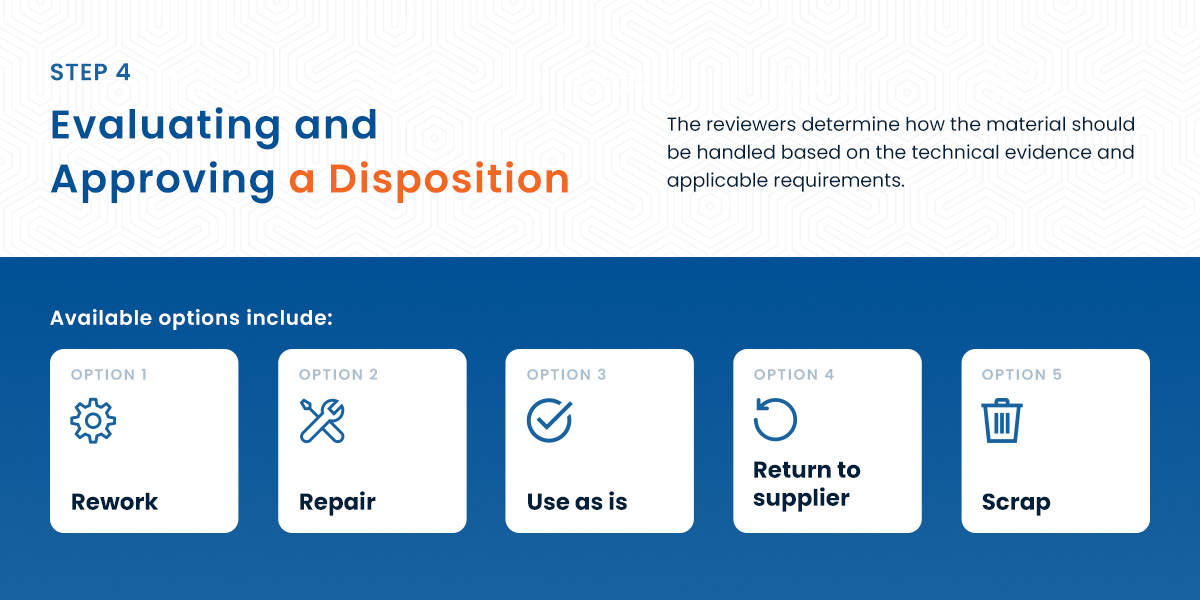
The reviewers determine how the material should be handled based on the technical evidence and applicable requirements. Available options include rework, repair, use as is, return to the supplier or scrap.
Approval authority depends on the disposition and the organization’s procedures. Under AS9100D, repair and use-as-is dispositions require authorization from a representative of the design organization or someone with delegated design authority. Customer authorization is also required when the nonconformance represents a departure from contract requirements.
5. Documenting the Decision
The MRB disposition record documents the nonconformance, the approved action, any concessions obtained and the identity of the approving authority. It should also include the supporting technical rationale and any instructions needed to carry out the decision.
Approvals must follow the organization’s quality procedures. Recording the decision establishes what must happen next, but does not, by itself, authorize the material’s release.
6. Implementing and Verifying the Disposition
Authorized personnel carry out the approved disposition. Reworked or repaired items undergo the inspection or testing specified in the approved instructions to verify that the required outcome has been achieved.
Records are updated to show the actions taken and the verification results. Material is released, returned or scrapped only after the applicable completion and authorization requirements have been met.
7. Evaluating the Need for Corrective Action
Disposition addresses the affected material. Corrective action addresses the cause of the nonconformance to help prevent it from happening again. The organization evaluates the need for corrective action based on the issue’s nature, consequences and recurrence. For supplier-related problems, this evaluation may include requesting a formal corrective action plan. When corrective action is taken, its effectiveness is reviewed to determine whether it has resolved the underlying problem.
What Are the MRB Disposition Options?
Each disposition defines what happens to the affected material and what approvals or verification activities are needed:
- Use as is: The item is accepted without correction following a documented technical evaluation and the required authorizations. Customer authorization is required when the nonconformance represents a departure from contract requirements.
- Rework: The item is brought back to full conformance with the original specification through additional processing, requiring documented instructions and a re-inspection afterward.
- Repair: The nonconforming item is restored to a condition that meets design intent but not necessarily the original specification. Repair requires documented approval from the design organization, along with customer authorization when applicable.
- Return to vendor: The nonconforming material is returned to the supplier for correction, replacement or credit, typically for supplier-caused issues where on-site correction isn’t feasible. A supplier corrective action request may also be issued based on the issue’s severity, recurrence and applicable requirements.
- Scrap: The item cannot be economically or technically restored to conformance and is disposed of, with documentation of why repair or rework isn’t feasible. Under AS9100D, scrapped items require clear, permanent marking or controlled handling until they can no longer be used or reenter the supply chain.
How to Catch Nonconformances Earlier
Identifying supplier quality issues before shipment gives organizations more time to resolve them before the affected material reaches production. Two services support this approach:
- Source inspection: Inspectors verify selected product characteristics and documentation at the supplier’s facility against specified requirements. Finding a nonconformance before shipment allows the supplier and customer to begin the required review and disposition earlier, reducing the risk of receiving unexpected nonconforming material.
- Supplier corrective action and development: When nonconformances recur from the same supplier, additional inspection alone may not address the cause. Supplier quality specialists help investigate the issue, develop corrective actions and evaluate whether those actions are effective.
Source inspection does not replace MRB review when a disposition is required. Instead, it moves detection earlier in the supply chain. Combined with effective supplier corrective action, it can help reduce repeat nonconformances and limit disruption to receiving and production.
Partner With Unitek Technical Services a Kiwa Company
Managing nonconforming material starts with a controlled review process. Reducing recurring issues also requires attention to supplier quality before products reach your facility.
Unitek Technical Services a Kiwa Company provides source inspection, product containment and supplier development to help organizations verify supplier conformance and address quality problems. Our technical specialists average over 45 years of experience, and our AS9100 certification supports our work as an approved supplier for aerospace OEMs.
Contact us today to discuss support for your supplier quality requirements.