
A supplier quote often arrives as a single number, with no breakdown of materials, labor or overhead and no way to check whether the price reflects what the part actually costs to produce. Should-cost analysis is a procurement method for estimating what a part should cost by modeling the materials, labor, overhead, tooling, logistics and supplier margin required to produce it.
When a price increase shows up later, this model gives procurement teams a fact-based way to evaluate the request instead of relying on the supplier’s explanation alone. For aerospace, defense and automotive procurement teams, this approach is especially useful when complex components, strict specifications and supplier process choices have a direct impact on cost.
Core Components of a Should-Cost Model
Procurement and cost engineering teams also refer to this practice as cost breakdown analysis or clean-sheet costing, depending on the industry. Federal acquisition policy defines should-cost review as a specialized form of cost analysis that evaluates the economy and efficiency of a contractor’s workforce, methods, materials, equipment, operating systems and management.
A complete should-cost analysis typically breaks a part down into these components:
- Raw materials: Price these using current market rates rather than historical or quoted figures.
- Direct labor: Multiply cycle time by a market-appropriate rate for the process and region where the part is made.
- Overhead: Facility, equipment and indirect staffing expenses get allocated across the production run.
- Tooling and non-recurring engineering: This line amortizes setup and development costs over the expected production volume.
- Freight and handling: Moving the part from the supplier to your facility, including packaging, falls under this category.
- Supplier margin: A reasonable profit margin, based on industry norms for the process and risk involved, rounds out the total.
Pairing this breakdown with a supplier capability assessment confirms that a supplier can actually execute the process the model assumes, rather than treating the cost estimate in isolation.
How to Build a Should-Cost Model in 6 Steps
Running a should-cost analysis comes down to a repeatable, step-by-step process procurement teams can apply to any part with a complex supply chain.
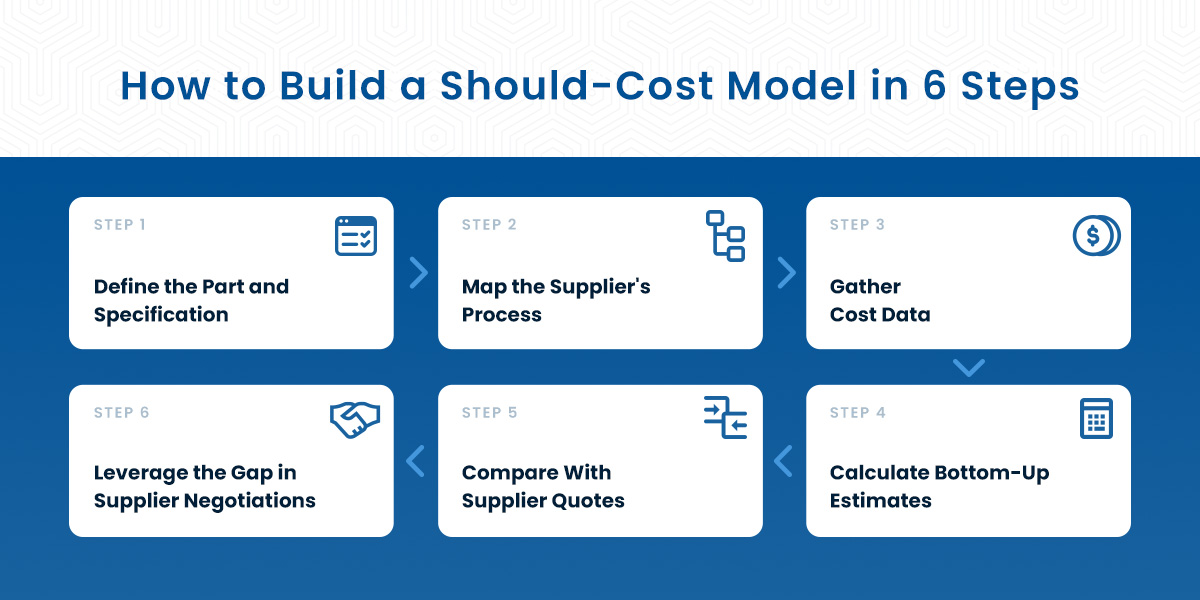
1. Define the Part and Specification
Start by identifying the exact part, drawing, material, revision level and production requirements being costed. The model should reflect the part as quoted, not a general version of it, so procurement and engineering teams are comparing the supplier’s price against the same scope.
2. Map the Supplier’s Process
Next, map how the supplier turns raw material into the finished part. This process view should cover major production steps, equipment used, inspection requirements, finishing operations and any outside processing. Mapping a supplier’s process often surfaces where a supplier capability assessment may be needed.
3. Gather Cost Data
From there, gather material prices, labor rates, cycle times and overhead figures specific to that process and region. Useful inputs include commodity indexes, supplier routings, ERP purchase history, engineering drawings, work instructions and regional labor benchmarks.
4. Calculate Bottom-Up Estimates
With data in hand, build the model cost-by-cost, multiplying cycle time by the applicable direct labor rate, applying current market pricing to the materials list and layering in overhead, tooling and logistics. Summing each line item produces a bottom-up should-cost estimate for the part, independent of any supplier’s quote.
5. Compare With Supplier Quotes
Once the model is complete, compare the should-cost total against the supplier’s quoted price line by line rather than as a single lump sum. This comparison surfaces exactly where the two numbers diverge, whether in materials, labor, overhead or margin, and by how much. It also gives engineering and procurement a shared view of which cost drivers are tied to design requirements, supplier process choices or commercial assumptions.
6. Leverage the Gap in Supplier Negotiations
Bring the line-item gap itself into the conversation with a supplier. A should-cost negotiation grounded in specific data points, such as an overhead rate that looks high for the process or a cycle time that does not match the expected routing, tends to produce a more productive discussion than disputing the bottom line alone. Procurement teams can use the model to ask targeted questions, validate assumptions and identify where design, process or commercial changes could close the gap.
Framing the conversation around supplier management strategies built on shared data helps preserve the supplier relationship while still giving your team a stronger basis for negotiation.
Why Should-Cost Models Need Shop-Floor Verification
A should-cost model is only as accurate as the process assumptions behind it. Cycle times, yields and capacity often come from general industry benchmarks, but every supplier’s actual shop-floor operations run a little differently. Confirming that data against the real production environment, including supplier routings, process records and inspection requirements, is what turns a desktop estimate into a model organizations can act on with objective evidence.
This verification often takes the form of supplier audits and surveys, which evaluate a supplier’s equipment, workforce and procedures, while source inspection services check the finished part before it leaves the facility. Together, these methods excel at catching cost and quality issues before production scales up, which helps reduce your supply chain risk at the point where a flawed assumption is least expensive to fix.
When to Use Should-Cost Analysis
Should-cost analysis delivers the most value when applied selectively rather than to every part in a bill of materials. Consider running a model when facing:
- High-spend parts: Parts that represent a significant share of program cost justify the time investment in a full model.
- Sole-source items: Limited supplier options remove competitive pressure, making an independent cost check more valuable.
- Price increase requests: A should-cost model provides procurement with a basis for evaluating whether a requested increase is justified.
- New supplier quotes: Running a should-cost estimate against new supplier quotes during qualification helps confirm pricing is reasonable before a contract is awarded.
- High-specification components: Aerospace, defense and automotive parts with detailed drawing requirements, quality standards or production controls often benefit from a closer look at the process assumptions behind the quote.
Frequently Asked Questions
A few questions come up often when procurement teams start building should-cost models:
What does a should-cost model look like?
A should-cost model usually looks like a cost-by-cost table, similar to the example above, with each line representing a step in how the supplier actually builds the item.
How is should-cost different from price analysis?
Price analysis compares a quoted figure against market rates, historical benchmarks or competing bids without examining how the part is made, while should-cost analysis instead evaluates the underlying cost drivers of production itself.
Does should-cost analysis work for non-machined parts?
Yes. The same bottom-up approach applies to castings, electronics assemblies, composites and other processes, as long as the process-specific cost data needed to build the model is available.
Turn Should-Cost Estimates Into Supplier-Ready Evidence
Confirming the process assumptions behind a should-cost model is where Unitek Technical Services comes in. Backed by over 50 years of experience in supplier quality and supply chain management, Unitek Technical Services partners with procurement and operations teams to verify the production assumptions a should-cost model depends on. That track record reflects a reputation built on Quality People, Quality Results.
Unitek Technical Services draws on supplier audits and surveys to confirm how a supplier actually operates and layers in source inspection services wherever a part’s risk calls for an extra check.
Scheduling and inspection results are available through Launchpad, the secure online portal from Unitek Technical Services, giving customers 24/7 access to the real-time status of their parts in the part acceptance process.
Contact Unitek Technical Services to turn a should-cost estimate into negotiation-ready data backed by real shop-floor evidence.